Research
The Best Superintelligence in Sovereign AI: 2026 Rankings
The ranking is the Sovereign AI Power Index's own, not our test.
Which country leads in sovereign AI? The 2026 Sovereign AI Power Index rankings: South Korea, the UAE, Singapore, the United States and the race for AI independence.
At a glance
- Type
- Research
- Topics
- Sovereign AI, AI sovereignty, Sovereign AI Power Index
- Evidence
- Third-party research
- Written by
- Liyam Flexer
The short answer
There is no verified artificial superintelligence, and no country has demonstrated one. In the Sovereign AI Power Index's Quarter 2, 2026 ranking, South Korea leads with 59.2, then the UAE, Singapore and the United States. The United States leads on compute but ranks fourth, because sovereign AI depends on the whole ecosystem.
What is the best superintelligence in sovereign AI?
There is currently no verified artificial superintelligence (ASI) that can be identified as the world's best sovereign AI system. No country has demonstrated a machine intelligence that meets an established definition of artificial superintelligence.
However, countries are competing to build something strategically important: sovereign AI capabilities that they can develop, operate, govern, and control themselves.
According to the Sovereign AI Power Index (SAPI), Quarter 2, 2026, South Korea ranks first in overall sovereign AI power, followed by the United Arab Emirates (UAE), Singapore, and the United States.
| Rank | Country | SAPI composite score |
|---|---|---|
| 1 | South Korea | 59.2 |
| 2 | United Arab Emirates | 58.9 |
| 3 | Singapore | 58.2 |
| 4 | United States | 57.5 |
| 5 | Estonia | 56.6 |
| 6 | France | 55.6 |
| 7 | Saudi Arabia | 54.2 |
| 8 | Oman | 52.7 |
| 9 | Japan | 50.6 |
| 10 | Italy | 48.8 |
Source: The Sovereign AI Power Index, Quarter 2, 2026, published July 2, 2026. Scores are the Index's composite assessments, not percentages of AI intelligence or model performance.
How to read this ranking. The scores are the Index's own, as published on 2 July 2026. We have not reproduced them and could not confirm them independently. Other measures look at different things: see what other sources say below.
The United States leads the index in compute capacity, scoring 91.0, but ranks fourth overall. South Korea leads because the index evaluates a broader combination of national capabilities, including capital, regulation, data sovereignty, and the ability to turn AI infrastructure into operational intelligence.
The central finding is that sovereign AI leadership is not determined by who owns the largest data center or develops the most powerful individual model. It depends on who controls and can sustain the entire intelligence ecosystem.
Explore the Sovereign AI Power Index
What is sovereign AI?
Sovereign AI is the ability of a country or organization to independently develop, deploy, operate, and govern artificial intelligence using infrastructure, data, models, talent, and operating systems that it can control.
It is about more than where data is stored. A country may host its data within national borders while relying on foreign-owned models, external cloud infrastructure, proprietary software, and overseas technology providers.
That arrangement can provide data residency without providing full AI sovereignty.
True sovereign AI requires meaningful control across the AI lifecycle: from energy and computing infrastructure to data acquisition, model development, intellectual property, deployment, governance, and decision-making.
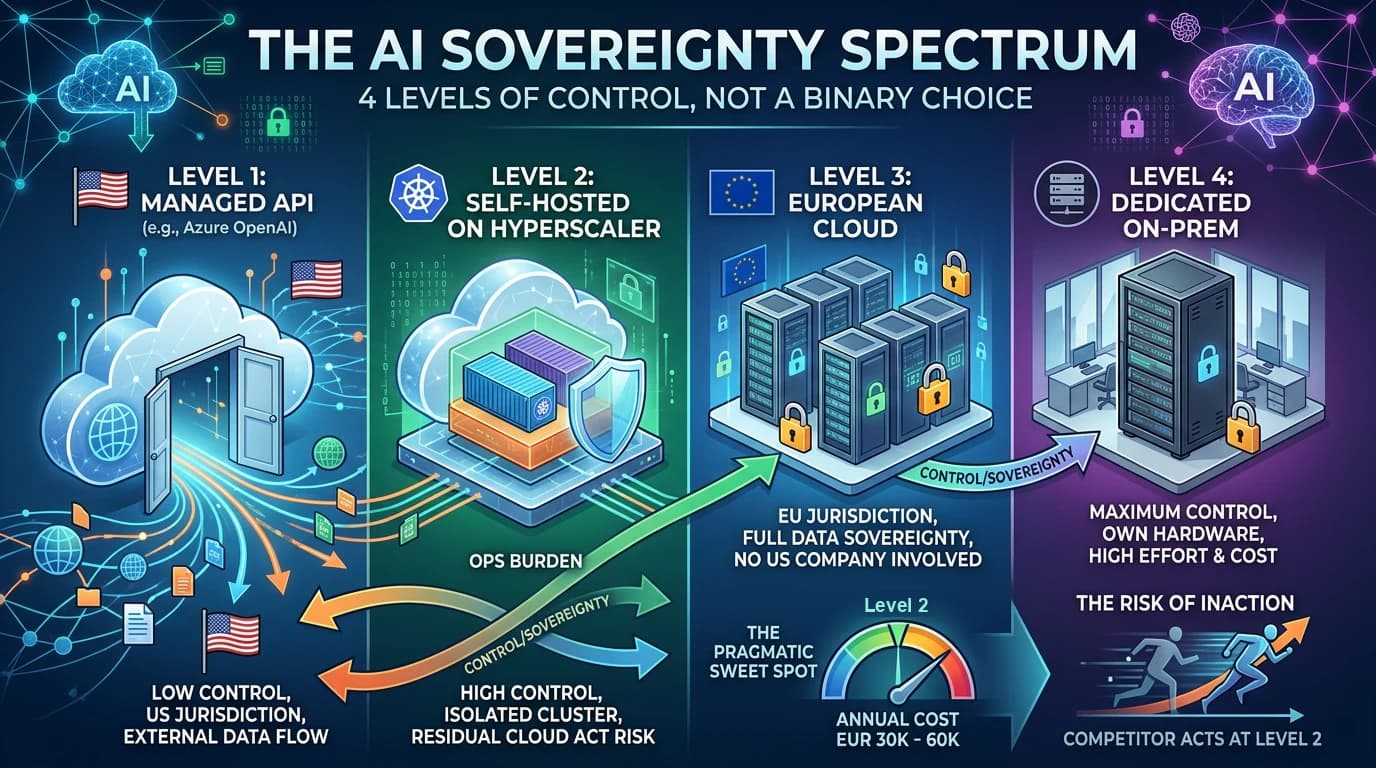
McKinsey describes sovereign AI through territorial, operational, technological, and legal dimensions. It also emphasizes that sovereignty exists on a spectrum rather than as a simple yes-or-no condition.
Source: McKinsey — What is sovereign AI?
The five dimensions of sovereign AI power
The Sovereign AI Power Index evaluates national capability through five dimensions. Together, they assess whether a country can turn AI ambition into durable strategic capacity.
1. Compute capacity
Compute capacity is the physical foundation of advanced AI.
It includes access to high-performance GPUs and accelerators, data centers, energy supply, grid capacity, and the infrastructure required to train and operate advanced models.
A country may develop excellent AI research but remain dependent on foreign infrastructure if it cannot reliably access the computing resources required to operate its systems.
Compute sovereignty means having reliable access to the infrastructure that makes independent AI development and deployment possible.
2. Capital formation
Developing sovereign AI requires sustained investment.
Capital formation measures the ability to direct public and private financial resources toward AI research, infrastructure, companies, and strategic national priorities.
This includes sovereign wealth investment, venture capital, government funding, institutional investment, and the financial mechanisms needed to support long-term AI development.
The objective is not simply to spend more money. It is to convert investment into lasting national capabilities, technology ownership, and productive AI ecosystems.
3. Regulatory readiness
AI systems operate within legal, regulatory, and institutional environments.
Regulatory readiness evaluates whether a country has the legal clarity, procurement frameworks, licensing pathways, and national AI policies needed to develop and deploy AI effectively.
A strong regulatory environment can encourage investment, support responsible innovation, establish security requirements, and enable government and enterprise adoption.
4. Data sovereignty
Data is one of the fundamental resources behind artificial intelligence.
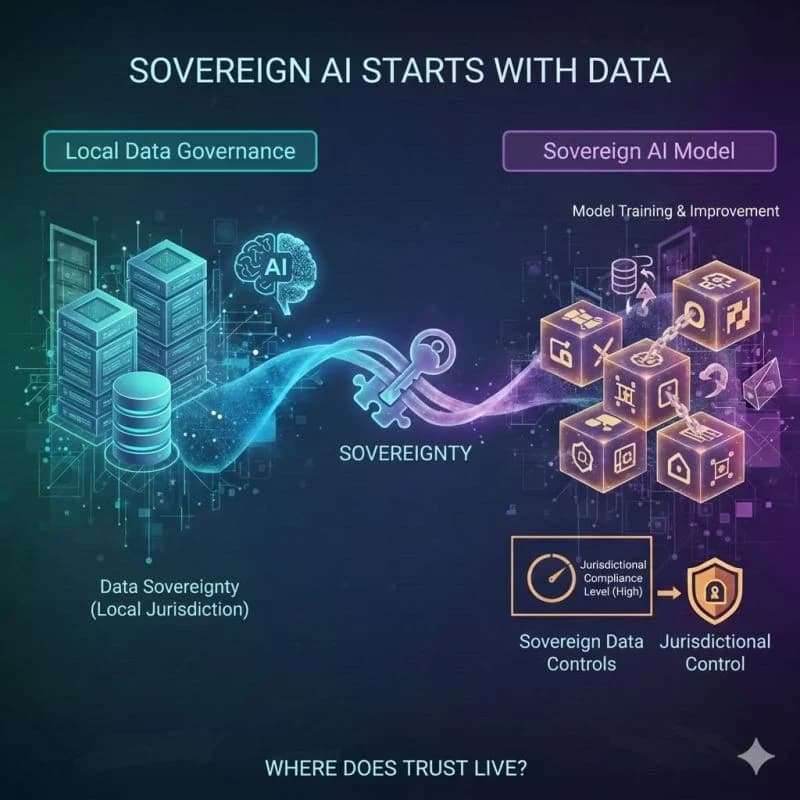
Data sovereignty concerns who controls strategic datasets, where they are stored and processed, which jurisdiction governs them, and whether sensitive information can be protected from unauthorized access.
For governments and organizations, this includes national datasets, public-sector information, industrial knowledge, healthcare records, financial information, research data, and proprietary business intelligence.
Without meaningful control over data, a country may remain dependent on external AI ecosystems even when it operates its own infrastructure.
5. Directed intelligence
Directed Intelligence is the Index's proprietary dimension. It evaluates how effectively a country or organization converts AI capability into measurable operational outcomes.
The distinction matters: possessing computing infrastructure, capital, data, and AI models does not automatically produce strategic advantage.
AI must be integrated into institutions, industries, government operations, and national priorities. It must support real decisions, deliver measurable results, and become part of durable operating systems.
The Index describes five stages of institutional adoption:
- Experimental: AI activity is fragmented and largely opportunistic.
- Emergent: Pilot programs exist, but national coordination remains inconsistent.
- Structured: Institutions have established mandates, funding paths, and operating models.
- Directed: AI capabilities are aligned with national priorities and supported by durable governance.
- Intelligence Fabric: AI is embedded across state operations as a coordinated national system.
Source: The Sovereign AI Power Index methodology
The 10 leading countries in sovereign AI
The following ranking reflects the published SAPI Quarter 2, 2026 composite scores. It is a ranking of national sovereign AI ecosystems, not a ranking of individual AI models or a measurement of artificial superintelligence.
1. South Korea — The leading sovereign AI ecosystem
SAPI score: 59.2 | Rank: 1
South Korea ranks first in the Sovereign AI Power Index, with a composite score of 59.2.
Its position reflects a coordinated approach to domestic AI development, industrial capability, national investment, and institutional adoption.
South Korea is pursuing sovereign foundation models through a government-backed program involving domestic technology companies and research organizations. The participating ecosystem includes SK Telecom, LG AI Research, Upstage, and other national AI developers.
The country's approach is particularly important because it seeks to reduce dependence on foreign foundation models by developing models and capabilities within its own technology ecosystem.
The Ministry of Science and ICT has defined its sovereign foundation model ambition around original model architecture, domestic pretraining, data acquisition and processing, and independently developed learning methods. This is a more demanding definition than simply fine-tuning a foreign model.
In the 2026 second-stage evaluation of the national project, SK Telecom ranked first, followed by Upstage and LG AI Research. These results are separate from the SAPI national composite score, but demonstrate the depth of South Korea's domestic model-development competition.
Why South Korea leads:
- A coordinated national sovereign AI program.
- Domestic foundation-model development.
- Strong technology and semiconductor industries.
- Collaboration between government, research institutions, and private companies.
- A focus on reducing dependence on foreign AI technology.
Assessment: South Korea is the current overall leader in the SAPI ranking and one of the strongest examples of a country building a coordinated domestic AI ecosystem.
Sources: South Korea's Ministry of Science and ICT | Yonhap — Sovereign AI project evaluation
2. United Arab Emirates — A strategic sovereign AI powerhouse
SAPI score: 58.9 | Rank: 2
The United Arab Emirates ranks second, just 0.3 points behind South Korea.
The UAE has positioned AI as a strategic national priority, combining investment, computing infrastructure, research, and government-led technology development.
One of its most visible AI initiatives is the Falcon family of models, developed by the Technology Innovation Institute (TII) in Abu Dhabi.
Falcon demonstrates the UAE's ambition to build AI technology locally rather than rely exclusively on models developed by foreign technology companies.
The Falcon ecosystem includes work on language models, Arabic-language capabilities, and efficient model architectures. In May 2025, TII announced Falcon Arabic and Falcon-H1, extending the family's focus on regional language capabilities and model efficiency.
The UAE's broader sovereign AI ecosystem also includes infrastructure providers, government initiatives, research institutions, and companies working on enterprise and public-sector AI.
Why the UAE ranks highly:
- Strategic national investment in AI.
- Government-supported AI research and development.
- Domestic AI model development through TII.
- Growing AI infrastructure and data-center capabilities.
- A strong focus on Arabic-language and regional AI applications.
Assessment: The UAE is one of the strongest examples of a country using national investment and institutional coordination to build sovereign AI capabilities.
Sources: Technology Innovation Institute | Falcon models
3. Singapore — Sovereign AI through institutional strength
SAPI score: 58.2 | Rank: 3
Singapore ranks third, demonstrating that sovereign AI leadership does not depend exclusively on building the largest domestic foundation model.
Its strategy emphasizes national coordination, AI infrastructure, research, talent, governance, and practical adoption.
Singapore's National AI Strategy 2.0, launched in December 2023, established a national framework for developing and deploying AI. In May 2026, the government announced refreshed priorities and the establishment of a National AI Council to provide strategic direction.
Singapore's position illustrates the importance of institutional readiness: a country must be able to deploy AI throughout its economy, establish effective governance, and develop the talent and infrastructure required to sustain its capabilities.
Why Singapore ranks highly:
- Coordinated national AI strategy.
- Strong regulatory and institutional environment.
- Advanced digital infrastructure.
- Investment in AI talent and research.
- Focus on practical adoption across government and industry.
Assessment: Singapore is a leading example of institutional and governance-driven sovereign AI development.
Source: Singapore Ministry of Digital Development and Information — National AI Strategy update, May 2026
4. United States — The global compute leader
SAPI score: 57.5 | Rank: 4
The United States has one of the world's most powerful AI ecosystems, with major frontier-model developers, advanced semiconductor technology, cloud infrastructure, research institutions, and private investment.
Its ecosystem includes companies such as OpenAI, Anthropic, Meta, Google, Microsoft, and leading semiconductor and infrastructure providers.
The United States receives the highest compute capacity score in the SAPI ranking: 91.0.
However, its overall position is fourth.
This difference is central to understanding sovereign AI. A country can dominate one dimension without achieving equally strong results across every dimension required for durable national capability.
The Index highlights a significant imbalance between US compute capacity and capital formation. Its published capital formation score is 35.7.
Why the United States remains a major AI power:
- Leading access to advanced computing infrastructure.
- Major frontier AI research and development.
- Globally influential AI companies.
- Strong semiconductor and cloud ecosystems.
- Significant private-sector innovation.
Assessment: The United States remains a global frontier AI powerhouse and the SAPI compute leader, but the Index's broader methodology places it fourth in overall sovereign AI capability.
5. Estonia — Digital government and institutional capability
SAPI score: 56.6 | Rank: 5
Estonia ranks fifth, demonstrating the importance of digital government, institutional coordination, and national technology infrastructure.
Its established digital-government ecosystem provides a foundation for integrating AI into public services and national operations.
Estonia's position is a reminder that sovereign AI is not exclusively a contest between the largest economies. Smaller countries can build meaningful strategic capabilities through effective institutions, digital infrastructure, and focused national priorities.
Assessment: Estonia is an important example of how digital-government maturity can contribute to sovereign AI development.
6. France — Building European AI independence
SAPI score: 55.6 | Rank: 6
France is an important player in Europe's effort to reduce dependence on external AI providers.
Its sovereign AI ambitions involve domestic research, European technology partnerships, national infrastructure, and public-sector adoption.
The country's broader strategic challenge is to translate its research and industrial strengths into a competitive AI ecosystem that can operate with greater technological independence.
Assessment: France represents an important European pathway toward strategic AI independence.
7. Saudi Arabia — Investment-led sovereign AI development
SAPI score: 54.2 | Rank: 7
Saudi Arabia is investing in AI as part of its wider economic and technological transformation.
Its strategy places significant emphasis on infrastructure, capital, national development priorities, and the use of AI across government and industry.
Its position in the SAPI ranking highlights the importance of converting national investment into durable technological and institutional capability.
Assessment: Saudi Arabia is an emerging sovereign AI power with a significant investment-led development strategy.
8. Oman — An emerging sovereign AI ecosystem
SAPI score: 52.7 | Rank: 8
Oman ranks eighth in the SAPI assessment.
Its position places it among the leading countries in the index's Developing tier, reflecting emerging national capability across the dimensions assessed.
The ranking should be interpreted as a measure of the Index's composite assessment, not as evidence that Oman has developed a frontier or superintelligent AI model.
Assessment: Oman is an emerging participant in the regional sovereign AI landscape.
9. Japan — Advanced technology and industrial foundations
SAPI score: 50.6 | Rank: 9
Japan brings substantial strengths in industrial technology, robotics, advanced manufacturing, research, and computing.
These capabilities provide a foundation for sovereign AI development, particularly in industrial and specialized applications.
Its strategic opportunity is to combine its established technology base with domestic AI models, infrastructure, and broader deployment.
Assessment: Japan has significant industrial and research foundations that can support the development of sovereign AI capabilities.
10. Italy — Developing European sovereign AI capacity
SAPI score: 48.8 | Rank: 10
Italy completes the top ten in the SAPI Quarter 2, 2026 ranking.
Its position reflects the country's developing role in the European AI ecosystem and the broader effort to strengthen domestic technological capabilities.
Assessment: Italy is part of Europe's growing sovereign AI landscape, with further opportunities to strengthen infrastructure, investment, and domestic AI development.
What other sources say
The SAPI ranking is one measure. Other published measures look at different things, such as notable models, patents and the maturity of locally owned language models. Here is what three sources we read on 3 November 2026 say, in their own words.
“Korea also ranked first globally in AI patents with 14.31 per 100,000 people”
The same report, according to the Korea Times, ranked Korea third in notable AI models last year, with five. That is a separate result from the SAPI composite and agrees with South Korea's strong standing in the SAPI ranking.
“The Middle East region had the world's most mature Sovereign AI LLMs in H1 2026”
Counterpoint's index looks at sovereign language models in terms of ownership, foundational build, local language depth and application, so it measures locally owned models rather than the whole national ecosystem. It is consistent with the UAE, Saudi Arabia and Oman all appearing in the SAPI top ten.
“Falcon-Emirati is a 7-billion-parameter model purpose-built for Emirati vocabulary, expressions and cultural context”
That is the kind of capability the sovereign AI argument turns on: a model built for a country's own language, culture and context rather than adapted from a foreign one.
The models and organizations behind sovereign AI
Sovereign AI is built by specific organizations. These are the ones named in the ranking above, with what they have published. Our own pages cover the models and products where we have reviews.
 Falcon, Technology Innovation Institute (UAE)
Falcon is the model family from the Technology Innovation Institute in Abu Dhabi. TII's Falcon page lists Falcon-H1, a hybrid of Transformer and Mamba architectures; Falcon-H1-Arabic and Falcon Arabic for Arabic and its dialects; Falcon-Emirati, a 7-billion-parameter model for Emirati vocabulary and context; Falcon-ASR for Emirati and Arabic speech transcription; Falcon-OCR-Arabic for text extraction from images; and Falcon Perception, a multimodal model that reads images with natural-language prompts. See Falcon LLM and TII.
 LG AI Research and the Korean foundation-model teams
South Korea's government-backed program involves SK Telecom, LG AI Research and Upstage, among other developers. In the 2026 second-stage evaluation described above, SK Telecom ranked first, followed by Upstage and LG AI Research. The program's aim is original architecture and domestic pretraining, not fine-tuning a foreign model.
 Mistral AI (France)
Mistral AI is a European company building foundation models, with open-weight releases and flexible deployment, which makes it a prominent example of Europe's push for AI independence. Read our Mistral Medium 3.5 model page and the top 10 AI companies guide.
 NVIDIA and the compute layer (United States)
Compute is where the United States scores highest in the SAPI ranking (91.0). Our top 10 AI companies guide describes NVIDIA as supplying much of the computing technology behind the AI industry, which is why countries weigh how much of their AI they can run on infrastructure they control. Frontier models from US labs are on our models page, for example GPT-6 Astra and Claude Opus 5.5.
What is the difference between sovereign AI and artificial superintelligence?
The terms are related to the future of artificial intelligence, but they describe different things.
Sovereign AI concerns control: who develops, owns, operates, governs, and can independently maintain AI systems.
Artificial general intelligence (AGI) refers to AI with broad capabilities across a wide range of cognitive tasks, rather than competence limited to a narrow application.
Artificial superintelligence (ASI) refers to a hypothetical form of artificial intelligence that substantially exceeds human cognitive capabilities across most or all relevant domains.
A sovereign AI system could use an advanced foundation model without being AGI or ASI. Likewise, a future superintelligent system could be developed by a private company or operate across international infrastructure without being sovereign to any one country.
The distinction is important because the SAPI ranking does not measure which country has developed the most intelligent model. It measures the national capabilities and institutional conditions that support independent AI development and deployment.
A country could become a sovereign AI leader without developing the world's most powerful frontier model. It could also develop an exceptionally capable model while remaining dependent on foreign computing infrastructure, software, or data.
The long-term strategic question is therefore not only who develops the most intelligent AI, but who retains meaningful control over the intelligence systems that shape its economy, institutions, and national security.
What does a country need to own to achieve true AI sovereignty?
AI sovereignty extends beyond owning servers, purchasing GPUs, or hosting data within national borders.
It requires control over the knowledge, technology, intellectual property, and decision-making processes that create and operate intelligent systems.
The most important assets include:
Process knowledge
The practical knowledge of how AI systems are designed, trained, evaluated, deployed, maintained, and improved.
Intellectual property
Ownership or enforceable control over the inventions, architectures, algorithms, software, research, and technologies that create strategic AI advantages.
Data
Control over the collection, ownership, processing, storage, access, and governance of strategic national and organizational datasets.
Core product development
The ability to design, build, improve, and maintain AI products without depending entirely on external technology providers.
Discovery and proprietary AI
The capacity to conduct independent research, discover new methods, develop proprietary models, and create original AI capabilities.
Private code base
Control over the software, source code, infrastructure tooling, and systems that enable AI development and operation.
Decision logic
Understanding and controlling how AI systems process information, make recommendations, execute instructions, and influence important decisions.
Engineering practices
The technical expertise, development processes, testing systems, security practices, and operational knowledge required to maintain advanced AI systems.
Invention
The ability to create original technologies, architectures, methods, and applications rather than merely adopting or adapting technologies developed elsewhere.
Quality standards
The ability to define, measure, verify, and enforce the performance, safety, reliability, and security requirements of AI systems.
Design trade-offs
The knowledge required to make independent decisions about performance, cost, latency, privacy, security, reliability, energy consumption, and model capability.
The underlying principle is straightforward: sovereignty means retaining the ability to create, understand, control, improve, and operate the intelligence systems on which an organization or nation depends.
A country that owns its data but cannot control its models, software, or infrastructure has only partial sovereignty.
A country that owns its infrastructure but depends on external technology for its core intelligence capabilities also has only partial sovereignty.
The strongest sovereign AI ecosystems retain control over the complete chain of technological and institutional value.
Can open-source AI models provide sovereign AI?
Yes, but open-source or open-weight models do not automatically guarantee sovereignty.
Using an externally developed model can provide a country with access to advanced AI capabilities. It may also allow local organizations to fine-tune, customize, and deploy models on domestic infrastructure.
However, the original model architecture, training process, weights, licensing terms, data, and development decisions may remain under external control.
The level of sovereignty depends on what can actually be controlled.
A useful distinction is:
| AI approach | Sovereignty implications |
|---|---|
| Foreign AI API | High dependence on an external provider |
| Foreign open-weight model hosted locally | Greater deployment and data control, but external model-origin dependencies |
| Locally fine-tuned model | More local customization, but inherited dependencies may remain |
| Domestically pretrained foundation model | Greater domestic control over model development |
| Independently developed AI stack | Potentially stronger end-to-end sovereignty, depending on infrastructure, IP, data, and operational control |
South Korea's government-backed foundation-model program illustrates a more demanding approach. Its stated definition of a sovereign foundation model emphasizes domestic model design and pretraining rather than simply fine-tuning a foreign model.
That does not mean every country must independently manufacture every semiconductor or develop every software component. Sovereignty is a spectrum, and strategic independence can be achieved through carefully managed partnerships, trusted suppliers, and diversified infrastructure.
The objective is to avoid critical dependencies that another organization or country can unilaterally control.
Why sovereign AI matters for the future of artificial superintelligence
As AI systems become more capable, control over their infrastructure, knowledge, and operating environments becomes increasingly important.
The development of more advanced AI could affect national security, economic competitiveness, scientific discovery, public administration, and the distribution of technological power.
Countries that depend entirely on external AI providers may face strategic risks involving service availability, foreign legal jurisdiction, technology restrictions, data access, and the ability to adapt systems to national requirements.
Sovereign AI offers a way to reduce these dependencies and build domestic capabilities.
However, sovereignty does not automatically make an AI system safe, aligned, transparent, or beneficial.
A nationally controlled AI system can still produce unreliable outputs, introduce bias, expose sensitive information, or create security risks. Strong governance, independent evaluation, accountability, and safety research remain essential.
The future of advanced AI will therefore involve two connected but distinct challenges:
- Intelligence capability: Developing increasingly capable AI systems, potentially progressing toward AGI and ASI.
- Intelligence sovereignty: Retaining meaningful control over the infrastructure, data, models, intellectual property, and governance that support those systems.
The countries that combine both capabilities may have a substantial strategic advantage.
The politics of superintelligence
Who controls advanced AI is a political question as much as a technical one. The short animation below, supplied with this article, shows portraits made of coloured dots. For the strategic argument about rivalry and restraint, read Superintelligent AI risks in 2026: why deterrence still matters.
Final verdict: The future belongs to those who control intelligence
The competition for sovereign AI is not simply a race to build the largest data centers, train the biggest models, or attract the most investment.
It is a competition to control the complete intelligence ecosystem: the infrastructure, data, models, research, intellectual property, software, engineering expertise, and institutions that make advanced AI possible.
South Korea currently leads the Sovereign AI Power Index, followed closely by the UAE and Singapore. The United States remains the strongest compute-capacity leader but ranks fourth in the overall assessment.
These results demonstrate that national AI power is multidimensional. Infrastructure alone is not enough. Capital alone is not enough. A powerful model alone is not enough.
The most strategically powerful sovereign AI ecosystem will be the one that can independently create, understand, secure, govern, and continuously improve its own intelligence capabilities.
There is no established sovereign artificial superintelligence champion today. But the countries building the foundations of independent intelligence are already competing to shape who controls the next era of AI.
Related on this site
- Superintelligence: the full encyclopedia article
- Superintelligent AI risks in 2026: why deterrence still matters
- Top 10 AI companies in 2026
- The best books on artificial superintelligence
- Sovereign AI in the glossary and the AI and SI Q&A
Evidence in this article Third-party research Work published by researchers or institutions other than us or the vendor. We link it; we have not reproduced it.
Frequently asked questions
Which country has the best sovereign AI in 2026?
According to the Sovereign AI Power Index's Quarter 2, 2026 ranking, South Korea is first with a composite score of 59.2. The UAE ranks second with 58.9, Singapore third with 58.2, and the United States fourth with 57.5.
Does the United States have the most powerful sovereign AI?
The United States has the highest compute capacity score in the SAPI ranking, at 91.0. However, it ranks fourth overall because the Index evaluates several dimensions of sovereign AI capability rather than computing infrastructure alone.
Is South Korea the world's leading sovereign AI country?
South Korea ranks first in the SAPI Quarter 2, 2026 assessment. Its national foundation-model development program and domestic AI ecosystem are important parts of its sovereign AI strategy. This ranking does not establish that South Korea has the world's most powerful AI model or an artificial superintelligence.
Is the UAE a leader in sovereign AI?
Yes. The UAE ranks second in the SAPI Quarter 2, 2026 ranking. Its AI ecosystem includes government-supported research, the Technology Innovation Institute, and the Falcon family of AI models.
What is the best sovereign AI model?
There is no universally accepted ranking that identifies one model as the best sovereign AI model across every country, language, application, and sovereignty requirement. Model performance, ownership, licensing, training provenance, infrastructure control, and deployment requirements all matter.
Is Falcon an artificial superintelligence?
No. Falcon is a family of large language models developed by the Technology Innovation Institute in the UAE. It is an example of domestic foundation-model development, not evidence of artificial general intelligence or artificial superintelligence.
What is the difference between sovereign AI and AI sovereignty?
The terms are closely related. Sovereign AI generally describes AI systems and capabilities developed or operated under meaningful national or organizational control. AI sovereignty describes the broader ability to determine how those systems, their infrastructure, data, technology, and governance are controlled.
Can a country achieve sovereign AI without developing its own foundation model?
A country can achieve meaningful levels of AI sovereignty through local infrastructure, data control, trusted partnerships, and locally operated models. However, independently developing foundation models can provide greater control over model architecture, training, and intellectual property. The appropriate level depends on strategic requirements and the dependencies a country is prepared to accept.
Does sovereign AI guarantee AI safety?
No. Sovereign control and AI safety are different requirements. A system can be nationally controlled and still be unsafe, unreliable, or poorly governed. Safety requires evaluation, security controls, monitoring, accountability, and ongoing research.
Has any country achieved complete sovereign AI?
The SAPI Quarter 2, 2026 assessment places all 50 assessed countries below the Advanced tier, with South Korea scoring highest at 59.2. The Index therefore identifies a leading group rather than a country that has achieved complete sovereign AI capability.
Related reading
- Category: Research & knowledge
Sources
- The Sovereign AI Power Index — Current rankings The Sovereign AI Power Index.
- The Sovereign AI Power Index — Methodology The Sovereign AI Power Index.
- McKinsey — What is sovereign AI? McKinsey.
- McKinsey — Sovereign AI: Building ecosystems for strategic resilience and impact McKinsey.
- South Korea Ministry of Science and ICT — Sovereign AI Foundation Model Project South Korea Ministry of Science and ICT.
- Technology Innovation Institute — Falcon AI models Technology Innovation Institute.
- Singapore Ministry of Digital Development and Information — National AI Strategy Singapore Ministry of Digital Development and Information.
- The Korea Times: Korea ranks 3rd globally in key AI models (Stanford AI Index 2026) The Korea Times.
- Middle East leads sovereign AI LLM race in H1 2026 Counterpoint Research.
- Falcon LLM Technology Innovation Institute.