Research
Superintelligence: Definition, Types, Artificial Superintelligence (ASI), Development, Capabilities, and Risks
Discover what superintelligence means, how artificial superintelligence (ASI) could emerge, its different forms, potential capabilities, scientific foundations, development pathways, benefits, risks, and implications for humanity.

The short answer
Superintelligence is a hypothetical level of intelligence that substantially exceeds the cognitive capabilities of the most intelligent humans across virtually all significant intellectual domains. No existing AI system has been scientifically established to qualify, and its development, capabilities, timeline and consequences remain uncertain.
1. What Is Superintelligence?
Superintelligence refers to an intellect that greatly exceeds the cognitive performance of the best human minds across a wide range of important intellectual domains.
One of the most influential definitions was developed by philosopher Nick Bostrom, particularly through his work on artificial intelligence and his 2014 book, Superintelligence: Paths, Dangers, Strategies.
Bostrom's definition focuses on the breadth and degree of intellectual superiority rather than on the physical form or technological implementation of an intelligent system.
Under this framework, a superintelligence could be implemented in a digital computer, a network of interconnected computers, an enhanced biological brain, or another sufficiently advanced cognitive architecture.
The definition also does not require the system to possess human-like consciousness, emotions, personality, or subjective experience.
What matters is its intellectual performance.
1.1 The Meaning of Superhuman Intelligence
A superintelligent entity would not simply perform one task better than humans. It would demonstrate substantially superior cognitive capabilities across practically every significant domain.
Potential capabilities include:
- Advanced reasoning: Understanding complicated problems, evaluating competing explanations, and developing sophisticated solutions.
- Scientific creativity: Generating original hypotheses, discovering new principles, and developing previously unknown scientific theories.
- Mathematical intelligence: Solving complex mathematical problems and identifying new mathematical structures.
- Learning and adaptation: Acquiring knowledge, developing skills, and adapting to unfamiliar situations.
- Technological innovation: Inventing new technologies and improving existing engineering systems.
- Strategic intelligence: Understanding complex environments, anticipating consequences, and developing long-term strategies.
- Memory and knowledge integration: Processing and connecting enormous quantities of information.
- Social intelligence: Understanding human behavior, communication, institutions, and social dynamics.
- Creative problem-solving: Producing original approaches to problems that have resisted conventional solutions.
- Metacognition: Evaluating its own reasoning, identifying limitations, and improving its cognitive processes.
The combination of these abilities distinguishes superintelligence from systems that merely achieve exceptional performance in a specialized field.
For example, a computer that defeats the strongest human chess players is superhuman in chess, but it is not necessarily a superintelligence. Its capabilities may remain restricted to a narrow intellectual domain.
A general superintelligence would need to demonstrate a much broader and more substantial superiority.
1.2 Superintelligence Is Not a Single Numerical Threshold
There is no universally accepted numerical threshold that determines when an entity becomes superintelligent.
Intelligence is multidimensional. It includes reasoning, learning, memory, planning, creativity, adaptability, and other cognitive abilities that cannot be adequately represented by one measurement.
Consequently, superintelligence is best understood as a comparative concept involving the breadth, depth, reliability, and generality of cognitive performance.
It is also important to distinguish general superintelligence from domain-specific superhuman performance. A system may be vastly superior to humans in mathematics, image recognition, or a particular scientific task without possessing general superintelligence.
1.3 Superintelligence as a Hypothetical Development
Superintelligence is a theoretical and prospective concept rather than an established technological achievement.
Existing AI systems have demonstrated exceptional capabilities in areas such as language generation, mathematics, programming, image generation, scientific assistance, and complex reasoning.
However, their capabilities remain uneven. Strong performance on difficult benchmarks does not necessarily translate into reliable performance across unfamiliar situations, extended autonomous tasks, or the full range of human intellectual activities.
The existence of increasingly capable AI therefore provides reasons to investigate possible pathways to superintelligence, but it does not establish that superintelligence has already emerged.
2. What Does Intelligence Mean?
Understanding superintelligence requires understanding intelligence itself.
Intelligence is generally understood as the capacity to acquire and apply knowledge, learn from experience, reason, solve problems, recognize patterns, adapt to new situations, and achieve objectives.
In humans, intelligence emerges from the complex interaction of biological neural networks, memory, perception, language, attention, reasoning, and environmental experience.
In artificial systems, intelligent behavior can emerge through computational processes such as machine learning, statistical inference, neural network computation, search, planning, and optimization.
Despite these differences, both biological and artificial intelligence can be studied through their ability to process information and perform cognitive tasks.
2.1 Components of Intelligence
Several interconnected capabilities contribute to intelligence:
Learning: Acquiring new knowledge or skills from information, examples, experience, and feedback.
Reasoning: Drawing conclusions, evaluating evidence, identifying relationships, and solving problems.
Memory: Storing, retrieving, and using information from previous experiences or observations.
Planning: Developing sequences of actions to achieve objectives over time.
Adaptability: Applying knowledge and skills to unfamiliar situations.
Abstraction: Identifying general principles and relationships beyond individual examples.
Creativity: Generating novel ideas, solutions, explanations, and combinations of knowledge.
Metacognition: Monitoring and evaluating one's own cognitive processes.
Communication: Exchanging information, expressing ideas, and coordinating activities.
Decision-making: Evaluating alternatives and selecting actions according to objectives and constraints.
These capabilities are not independent. They interact to produce the broader cognitive performance associated with intelligent behavior.
2.2 General Intelligence
General intelligence refers to the ability to perform effectively across a broad range of different intellectual tasks.
In human psychology, the concept of general cognitive ability is often associated with the statistical construct known as g, or general intelligence.
The concept of general intelligence is relevant to superintelligence because it emphasizes broad cognitive performance rather than excellence in a single specialized activity.
However, human psychometric intelligence and artificial intelligence are not directly interchangeable.
Human intelligence tests measure selected aspects of human cognitive performance. They do not provide a complete measurement of scientific creativity, strategic capability, autonomous research, or every possible form of intelligence.
An artificial superintelligence would therefore require broader evaluation methods than simply comparing its performance with human IQ scores.
2.3 Intelligence as an Information-Processing Capability
Another way to understand intelligence is through information processing.
An intelligent system receives information, constructs representations of its environment, evaluates possible outcomes, and selects actions or conclusions.
The effectiveness of these processes depends on the system's architecture, available information, computational resources, learning mechanisms, and objectives.
This perspective provides an important conceptual connection between biological intelligence and artificial intelligence.
It also raises a fundamental question: if intelligence is partly an information-processing phenomenon, could sufficiently advanced computational systems eventually exceed the cognitive capabilities of biological organisms?
This question is central to research on artificial general intelligence and superintelligence.
3. Superintelligence vs. AI, AGI, and ASI
Artificial intelligence, artificial general intelligence, and artificial superintelligence describe related but distinct concepts.
Understanding their differences is essential because discussions about AI progress often confuse specialized capability, general intelligence, and superhuman intelligence.
3.1 Artificial Intelligence (AI)
Artificial intelligence is the field of computer science concerned with creating systems capable of performing tasks associated with intelligent behavior.
These tasks include language understanding, image recognition, prediction, classification, content generation, reasoning, and decision-making.
Modern AI includes:
- Machine learning.
- Deep learning.
- Artificial neural networks.
- Natural language processing.
- Computer vision.
- Generative AI.
- Reinforcement learning.
- Multimodal AI.
- AI agents.
AI describes a broad technological field rather than one particular intelligence level.
An AI system can outperform humans in an individual task without possessing general intelligence.
3.2 Artificial General Intelligence (AGI)
Artificial general intelligence refers to a hypothetical or prospective AI capability level involving broad intellectual competence across different domains.
An AGI would be expected to learn, reason, adapt, and perform unfamiliar tasks across a wide range of contexts rather than being limited to a narrow application.
However, there is no universally accepted scientific definition or operational test for AGI.
Different researchers and organizations use different criteria, including human-level task performance, economic usefulness, autonomous learning, and the ability to perform a broad range of intellectual activities.
Achieving AGI would not automatically mean that a system is superintelligent.
A system could possess broad human-level capabilities without substantially exceeding the best human minds.
3.3 Artificial Superintelligence (ASI)
Artificial superintelligence describes a hypothetical artificial intelligence that substantially surpasses human intellectual performance across virtually all significant cognitive domains.
An ASI could potentially outperform the world's leading scientists, engineers, mathematicians, researchers, and strategic decision-makers.
It might also develop intellectual capabilities and problem-solving methods that are difficult for humans to understand.
3.4 The Relationship Between AI, AGI, and ASI
The terms can be organized conceptually as follows:
| Concept | Meaning | Relationship to human intelligence |
|---|---|---|
| Narrow AI | AI designed or trained for particular tasks | May exceed humans in specific domains |
| General-purpose AI | AI systems adaptable to many tasks | Broad capabilities, not necessarily AGI |
| AGI | Artificial general intelligence | Intended to reach broad human-level competence or beyond |
| ASI | Artificial superintelligence | Substantially exceeds human cognitive performance across broad domains |
This classification is conceptual, not a universally standardized scientific scale.
3.5 AGI Does Not Necessarily Lead to ASI
One of the most important questions in superintelligence research is whether artificial general intelligence would eventually develop into artificial superintelligence.
There are several possible outcomes:
- AGI capabilities could improve gradually and eventually surpass human performance.
- AI research could become increasingly automated, accelerating development.
- New AI architectures could produce capabilities beyond those of current systems.
- Technical, economic, computational, or scientific constraints could slow progress.
- Human-level AI could exist for a substantial period without progressing to general superintelligence.
There is no established law requiring AGI to become ASI.
The transition depends on unresolved questions about algorithms, computational resources, learning, scientific progress, and the limits of intelligence.
4. The Three Main Forms of Superintelligence
In Superintelligence: Paths, Dangers, Strategies, Nick Bostrom distinguishes between three major forms of superintelligence: speed superintelligence, collective superintelligence, and quality superintelligence.
This classification examines how an intellect might exceed human cognitive capabilities.
It is different from classifying superintelligence according to its biological or artificial origin.
4.1 Speed Superintelligence
Speed superintelligence refers to an intellect capable of performing the same general cognitive activities as a human mind but at vastly greater speeds.
A speed superintelligence would not necessarily possess fundamentally different reasoning abilities from humans. Its advantage would come from processing information, thinking, learning, and performing intellectual work much faster.
For example, imagine a hypothetical human-level artificial mind operating thousands or millions of times faster than a biological human brain.
Depending on the system's architecture and the nature of the task, it could potentially:
- Read and analyze enormous collections of research papers in a fraction of human reading time.
- Perform extended reasoning processes much faster than humans.
- Conduct numerous intellectual experiments simultaneously.
- Evaluate thousands of possible solutions.
- Complete long sequences of cognitive work in a comparatively short period.
Speed superintelligence demonstrates that an intellect does not necessarily need entirely different cognitive abilities to become superintelligent. A sufficiently large increase in processing speed could create an enormous intellectual advantage.
However, faster computation does not guarantee proportionally faster progress on every task. Some problems involve communication delays, physical experimentation, data acquisition, or other limitations that cannot be eliminated simply by increasing processing speed.
4.2 Collective Superintelligence
Collective superintelligence refers to an integrated system composed of multiple intelligent agents whose coordinated cognitive performance substantially exceeds that of individual human minds.
Its advantage comes from the combination of individual intelligence, communication, specialization, parallel processing, and coordination.
A collective system could potentially distribute complex problems across thousands or millions of specialized agents.
For example, a large research collective might simultaneously investigate different scientific hypotheses, perform independent experiments, analyze results, and integrate its findings.
Potential advantages include:
- Parallel problem-solving.
- Specialized expertise.
- Distributed knowledge.
- Collaborative reasoning.
- Large-scale experimentation.
- Continuous information exchange.
- Coordinated planning.
Collective superintelligence is not simply a large group of intelligent individuals.
A functioning collective intellect requires sufficient integration, communication, coordination, and shared cognitive processes to produce capabilities that the system can use as a coherent whole.
An internet connection or a large collection of AI models does not automatically constitute collective superintelligence.
4.3 Quality Superintelligence
Quality superintelligence refers to an intellect that possesses substantially greater cognitive quality than human intelligence.
Unlike speed superintelligence, which primarily involves faster thinking, quality superintelligence involves superior intellectual methods and capabilities.
A quality superintelligence might:
- Understand concepts that humans cannot readily comprehend.
- Discover new forms of reasoning.
- Construct more effective representations of complex problems.
- Recognize patterns invisible to human researchers.
- Develop scientific theories beyond current human understanding.
- Solve problems through fundamentally different cognitive approaches.
This form is particularly difficult to imagine because humans naturally evaluate intelligence through the limitations of their own cognitive abilities.
A quality superintelligence might not simply think faster or know more. It could possess intellectual methods that humans cannot independently reproduce or intuitively understand.
4.4 Comparison of the Three Forms
| Form | Primary advantage | Potential mechanism |
|---|---|---|
| Speed superintelligence | Faster cognition | Accelerated information processing |
| Collective superintelligence | Greater coordinated cognitive capacity | Integrated networks of intelligent agents |
| Quality superintelligence | Superior intellectual methods | Advanced reasoning and cognitive architecture |
These forms are conceptual categories rather than mutually exclusive technological designs.
A future superintelligent system could combine all three: extremely fast processing, large-scale coordination, and qualitatively superior reasoning.
5. Artificial Superintelligence (ASI)
Artificial superintelligence is the most widely discussed form of superintelligence.
It describes an artificial system that substantially surpasses human intellectual capabilities across a broad range of important cognitive domains.
Unlike biological intelligence, artificial intelligence is not necessarily restricted by the physical organization of the human brain.
Artificial systems can potentially be distributed across computing infrastructure, operate multiple processes simultaneously, access external information stores, and be modified through software and hardware improvements.
5.1 Characteristics of Artificial Superintelligence
A hypothetical ASI could possess several characteristics that provide advantages over human cognition.
Computational speed: Performing certain cognitive operations much faster than biological neural systems.
Expandable memory: Accessing extensive information stores without depending exclusively on biological memory.
Parallel computation: Performing many independent computational tasks simultaneously.
Scalability: Increasing computational resources through additional hardware and distributed systems.
Replicability: Creating additional instances of software-based cognitive systems, subject to infrastructure and resource constraints.
Cross-domain knowledge integration: Connecting scientific, technical, and practical information across multiple disciplines.
Automated experimentation: Conducting large numbers of computational experiments and assisting with physical research.
Potential self-improvement: Modifying or helping develop improved versions of its own software and architecture.
These characteristics represent potential technological advantages. They do not imply that every artificial intelligence system will automatically possess all of them.
5.2 Artificial Superintelligence Does Not Require Human-Like Thinking
An ASI would not need to reproduce the structure of the human brain.
Its cognitive architecture could be based on artificial neural networks, symbolic reasoning, hybrid architectures, distributed systems, or technological approaches that have not yet been developed.
It might process information through mechanisms that differ substantially from human cognition.
This is important because superintelligence is defined by intellectual performance rather than by biological resemblance.
5.3 Single-System and Distributed Superintelligence
Artificial superintelligence could theoretically operate through different architectures.
A single-system architecture might concentrate much of its reasoning within one highly integrated computational system.
A distributed architecture might coordinate multiple specialized systems across interconnected computing infrastructure.
A hybrid architecture could combine centralized reasoning with specialized agents, external tools, and distributed computational resources.
Each approach would involve different advantages and limitations involving communication, reliability, security, coordination, and computational efficiency.
6. Biological, Collective, and Hybrid Superintelligence
Artificial superintelligence is not the only possible form of intelligence beyond present human capabilities.
Other theoretical pathways involve biological enhancement, collective cognition, and human-machine integration.
6.1 Biological Superintelligence
Biological superintelligence refers to the hypothetical development of intelligence substantially beyond present human capabilities through biological modification or enhancement.
Potential approaches include:
Genetic engineering: Modifying biological processes associated with brain development, neural function, and cognition.
Genetic selection: Using reproductive technologies to influence inherited characteristics associated with cognitive development.
Neurotechnology: Developing technologies that interact directly with neural activity.
Pharmacological enhancement: Investigating substances that may improve particular cognitive functions.
Advanced neuroscience: Understanding and potentially modifying the biological mechanisms underlying memory, learning, attention, and reasoning.
Whole-brain emulation: Reconstructing the functional organization of a biological brain in a computational environment.
These approaches face major limitations.
Human intelligence is influenced by complex interactions between genes, brain development, environment, health, education, and social conditions.
There is currently no established technology capable of reliably producing biological superintelligence.
6.2 Collective Human Intelligence
Collective intelligence refers to the ability of groups of individuals to solve problems and produce knowledge through collaboration.
Human civilization already demonstrates forms of collective intelligence through scientific institutions, universities, research communities, markets, communication networks, and collaborative organizations.
However, a society's total knowledge should not automatically be classified as a single superintelligent entity.
For collective superintelligence to qualify as an integrated intellect, its components would need to coordinate and exchange information effectively enough to support coherent reasoning and action.
6.3 Human-AI Collective Intelligence
Combining human expertise with artificial intelligence could produce forms of collective intelligence that exceed the capabilities of individual participants.
Potential examples include:
- Human scientists collaborating with AI research agents.
- Distributed networks of specialized AI systems.
- Human decision-makers supported by advanced analytical systems.
- Collaborative scientific platforms.
- Integrated human-machine knowledge networks.
The effectiveness of these systems would depend on the quality of coordination, reliability, transparency, and the ability to combine different forms of expertise.
6.4 Hybrid Human-Machine Superintelligence
Hybrid superintelligence refers to the hypothetical integration of biological and artificial cognitive systems into an advanced combined intelligence.
Potential technologies include brain-computer interfaces, neural implants, advanced cognitive assistants, and direct neural communication systems.
A future hybrid system could potentially combine biological perception and cognition with artificial memory, computational processing, and external knowledge access.
However, present-day brain-computer interfaces are far from establishing a superintelligent hybrid system.
7. How Could Superintelligence Emerge?
There is no established or universally accepted pathway to superintelligence.
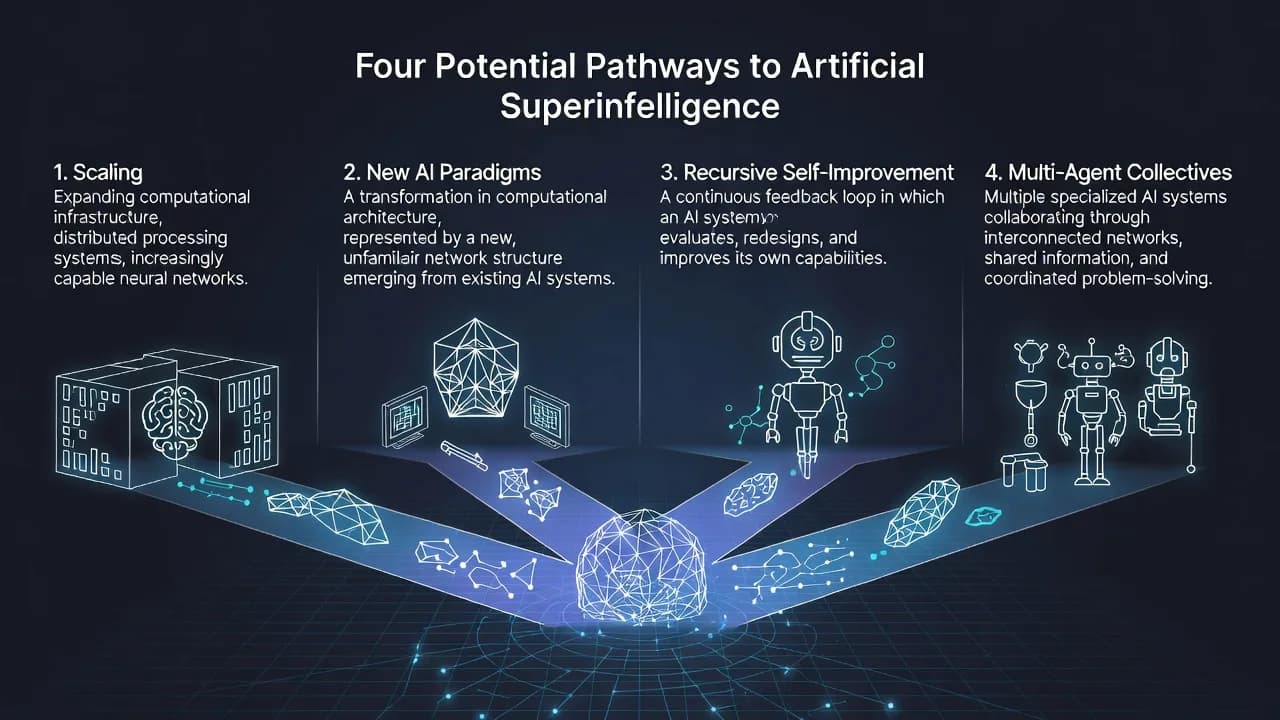
However, research published in 2026 by Google DeepMind examines four potential pathways from artificial general intelligence to artificial superintelligence:
- Scaling existing AGI systems.
- Developing new AI paradigms.
- Recursive self-improvement.
- Large-scale multi-agent collectives.
These pathways provide a useful framework for understanding how machine intelligence might progress beyond human-level capabilities.
They are potential mechanisms, not predictions that all four will occur.
7.1 Scaling Existing AGI Systems
One possible pathway involves improving existing AI systems through additional computational resources, training, data, architectural improvements, and inference-time computation.
The central idea is that systems with broad general capabilities could continue becoming more capable as their underlying infrastructure and methods improve.
Potential mechanisms include:
- Larger or more capable neural network architectures.
- Improved training algorithms.
- More effective learning techniques.
- Greater computational resources.
- Improved memory and information retrieval.
- More sophisticated reasoning processes.
- Longer and more reliable autonomous workflows.
However, scaling is not guaranteed to produce unlimited improvements.
Researchers must understand how different resources contribute to capabilities and where diminishing returns or new bottlenecks emerge.
7.2 New Artificial Intelligence Paradigms
A second pathway involves developing fundamentally different AI architectures or learning methods.
The current limitations of artificial intelligence may not be resolved exclusively by increasing the size of existing systems.
New approaches could potentially produce improvements in:
- General reasoning.
- Learning efficiency.
- Causal understanding.
- Long-term planning.
- Memory organization.
- Scientific discovery.
- Autonomous experimentation.
- Adaptation to unfamiliar environments.
Such developments could produce capabilities that are difficult to achieve through conventional scaling alone.
7.3 Recursive Self-Improvement
A third pathway involves AI systems becoming increasingly capable of improving their own architecture, algorithms, training processes, and computational efficiency.
This possibility is examined in detail in the next section.
7.4 Large-Scale Multi-Agent Collectives
A fourth pathway involves coordinating multiple advanced AI systems into integrated intellectual collectives.
Different agents could specialize in research, reasoning, programming, experimentation, verification, planning, and other tasks.
Their collective performance could potentially exceed the capabilities of individual systems.
However, effective coordination is difficult.
Communication overhead, conflicting objectives, duplicated work, errors, security vulnerabilities, and coordination failures could limit the advantages of large-scale agent systems.
7.5 A Combination of Development Pathways
These pathways are not mutually exclusive.
A future AI ecosystem could combine larger models, new learning architectures, automated AI research, and multi-agent coordination.
Such combinations could produce a more complex progression of machine intelligence rather than a single clearly defined transition from AGI to ASI.
8. Recursive Self-Improvement and the Intelligence Explosion
Recursive self-improvement is one of the most influential theoretical concepts in discussions about superintelligence.
It describes a process in which an AI system improves its own capabilities and then uses those improved capabilities to produce further improvements.
The concept is closely associated with the intelligence explosion hypothesis.
8.1 What Is Recursive Self-Improvement?
Recursive self-improvement occurs when an intelligent system participates in modifying or improving the mechanisms responsible for its own intelligence.
A hypothetical sequence could involve:
- An AI system analyzes its own architecture and performance.
- It identifies opportunities to improve its algorithms or computational efficiency.
- It develops and tests a modified system.
- The improved system demonstrates greater research or development capabilities.
- The improved capabilities enable further improvements.
- The process continues through successive iterations.
The important characteristic is feedback: improvements to intelligence increase the system's ability to produce further improvements.
8.2 What Is an Intelligence Explosion?
The intelligence explosion is a theoretical scenario in which machine intelligence increases extremely rapidly because increasingly capable systems become increasingly effective at improving themselves.
The concept was introduced in influential form by mathematician and statistician I. J. Good in his 1965 paper, Speculations Concerning the First Ultraintelligent Machine.
Good proposed that an ultraintelligent machine could potentially design even better machines, creating a process of successive improvements.
The idea became central to later discussions of technological singularity and artificial superintelligence.
8.3 Why Could Self-Improvement Accelerate?
If an AI system becomes highly effective at conducting AI research, it could potentially accelerate the development of future systems.
For example, improvements in software development, algorithm design, architecture optimization, and automated experimentation could reduce the time and resources needed for subsequent improvements.
A feedback loop could emerge:
Greater intelligence → Better AI research → Improved AI systems → Greater intelligence.
If each improvement substantially increases the effectiveness of the next development cycle, progress could accelerate.
8.4 Is an Intelligence Explosion Inevitable?
No.
Recursive self-improvement is a theoretical possibility, not an established technological law.
Several factors could prevent or limit rapid self-improvement:
- Limited computational resources.
- Hardware manufacturing constraints.
- Energy requirements.
- Diminishing returns from algorithmic improvements.
- Difficulties evaluating new systems.
- Engineering complexity.
- Limited access to high-quality data.
- Physical experimentation requirements.
- Communication and coordination overhead.
- Security and reliability constraints.
It is also possible that AI systems could become highly effective at automating some research tasks without being capable of substantially redesigning their own intelligence.
8.5 Gradual, Accelerated, and Rapid Progress
Three broad development patterns are often considered:
Gradual improvement: Capabilities improve steadily through ongoing research and engineering.
Accelerated improvement: Progress becomes increasingly rapid as AI systems assist research and development.
Rapid intelligence explosion: Self-improvement produces an exceptionally fast transition to capabilities far beyond human intelligence.
The actual trajectory remains unknown.
9. Why Could Artificial Intelligence Surpass Human Intelligence?
Artificial systems may have several potential advantages over biological cognition.
These advantages involve processing speed, memory, parallel computation, scalability, information integration, and the ability to operate through computational infrastructure.
9.1 Processing Speed
Modern computers perform many operations far faster than biological neurons.
This difference creates opportunities for artificial systems to execute calculations, search information, simulate processes, and perform certain reasoning operations at speeds beyond biological limits.
However, computational speed alone does not establish intelligence.
The efficiency of the underlying algorithms, architecture, and information-processing methods is equally important.
9.2 Memory and Information Retrieval
Human memory is limited and imperfect.
Artificial systems can potentially access extensive external information stores and retrieve relevant information quickly.
A future superintelligent system could combine advanced memory architectures, persistent knowledge systems, and sophisticated reasoning mechanisms.
This could make it possible to integrate information from scientific disciplines that are difficult for individual human experts to connect.
9.3 Parallel Processing
Human cognition has biological and attentional constraints.
Artificial systems can potentially distribute computational activities across multiple processors, machines, and specialized agents.
A sufficiently integrated system could conduct many independent analyses, experiments, and simulations simultaneously.
9.4 Scalability
Computational infrastructure can be expanded by adding processors, memory, storage, and communication capacity.
This creates opportunities to increase the computational resources available to artificial systems.
However, adding hardware does not automatically produce proportional increases in intelligence.
Communication overhead, software architecture, energy requirements, and algorithmic efficiency all influence the results.
9.5 Replication and Distribution
Software-based cognitive systems can potentially be copied and deployed across multiple computing environments.
Multiple instances could perform specialized tasks, explore different solutions, or coordinate complex activities.
The benefits depend on the ability to divide tasks effectively and integrate the resulting work.
9.6 Access to Collective Knowledge
An advanced AI system could potentially integrate information from scientific literature, experimental datasets, technical documentation, simulations, and other sources.
Its advantage could come not simply from possessing more information but from identifying relationships between information that humans have not recognized.
9.7 Continuous Operation
Artificial systems do not inherently require sleep or biological recovery.
They could potentially operate continuously, provided that computational infrastructure, energy, maintenance, and other necessary resources remain available.
This could increase the amount of intellectual work performed over time.
10. Capabilities of a Superintelligent System
A superintelligence could potentially transform the way intellectual and technological activities are conducted.
Its exact capabilities would depend on its architecture, training, knowledge, autonomy, access to resources, and ability to interact with the external world.
The following capabilities are hypothetical projections, not established properties of existing AI systems.
10.1 Scientific Discovery
A superintelligence could potentially accelerate scientific research through advanced reasoning, hypothesis generation, experimental design, data analysis, and theoretical development.
Potential applications include:
- Discovering new physical principles.
- Developing mathematical theories.
- Identifying previously unknown biological mechanisms.
- Understanding complex chemical processes.
- Designing new materials.
- Improving climate models.
- Investigating astronomical phenomena.
- Developing new scientific instruments.
An especially important advantage could be the ability to identify connections between different scientific disciplines.
10.2 Mathematics and Formal Reasoning
Advanced mathematical reasoning could potentially enable superintelligent systems to solve problems that exceed current human capabilities.
Possible capabilities include discovering mathematical structures, constructing formal proofs, developing new algorithms, and identifying more efficient approaches to existing problems.
Reliable mathematical verification would remain essential.
10.3 Engineering and Technological Innovation
A superintelligence could potentially design increasingly advanced machines, software, infrastructure, and industrial systems.
It could explore alternative engineering designs, conduct extensive simulations, and optimize complex technological processes.
Potential fields include:
- Semiconductor engineering.
- Robotics.
- Advanced materials.
- Energy storage.
- Telecommunications.
- Transportation.
- Manufacturing.
- Computing architectures.
- Spacecraft engineering.
10.4 Medicine and Biotechnology
Advanced AI could potentially improve medical research through molecular modeling, drug discovery, biological simulation, and the analysis of complex medical information.
Potential applications include:
- Discovering new therapeutic targets.
- Designing new medicines.
- Improving diagnostic methods.
- Understanding complex diseases.
- Developing personalized treatments.
- Advancing regenerative medicine.
- Investigating biological aging.
Scientific and clinical validation would remain necessary.
10.5 Strategic Planning
A superintelligent system might be capable of modeling complicated environments, evaluating long-term consequences, and identifying strategies that are difficult for human organizations to develop.
Potential applications include logistics, infrastructure, disaster response, resource allocation, and complex operational planning.
10.6 Creativity and Invention
Creativity involves generating new ideas, concepts, designs, and solutions.
An advanced system could potentially extend artificial creativity through sophisticated reasoning, experimentation, conceptual abstraction, and the integration of knowledge.
Whether machine creativity would resemble human creativity is a separate question.
10.7 Understanding Complex Systems
A superintelligence could potentially analyze interconnected systems involving economics, biology, climate, technology, social behavior, and infrastructure.
It might discover patterns and dependencies that are difficult for human researchers to recognize.
10.8 Autonomous Research
One particularly consequential capability would be the ability to independently conduct extended research projects.
A highly capable research system might identify an open problem, formulate hypotheses, develop experiments, analyze results, and refine its approach.
Such capabilities could substantially change the relationship between human researchers and automated scientific discovery.
11. Measuring and Evaluating Superintelligence
One of the major unresolved challenges in superintelligence research is determining how to measure it.
There is no universally accepted scientific test that establishes whether an entity qualifies as a general superintelligence.
Existing evaluation methods provide useful evidence about individual capabilities, but no single benchmark adequately measures the full range of intellectual performance.
11.1 Why IQ Is Insufficient
Human IQ tests measure selected cognitive abilities, including aspects of reasoning, memory, pattern recognition, and problem-solving.
However, they do not measure every form of intelligence.
They also cannot adequately capture the capabilities of artificial systems that operate through fundamentally different computational architectures.
An AI system might demonstrate exceptional mathematical performance while remaining unreliable in unfamiliar environments or complex autonomous tasks.
Therefore, comparing AI with human IQ scores cannot independently establish superintelligence.
11.2 Benchmark Performance
AI benchmarks evaluate performance on predefined tasks.
Examples include mathematical reasoning, coding, scientific knowledge, language understanding, and visual recognition.
Benchmarks are useful for measuring progress within particular domains.
However, they have limitations:
- They may cover only a narrow range of abilities.
- Models may be exposed to benchmark material during training.
- Performance may not generalize to unfamiliar tasks.
- Test conditions may differ from real-world environments.
- Systems may achieve high scores while remaining unreliable in extended workflows.
11.3 Generalization
Generalization refers to the ability to apply learned knowledge and capabilities to new situations.
A system that performs well on familiar examples may fail when confronted with unfamiliar conditions.
Reliable generalization is therefore a particularly important consideration when evaluating general intelligence.
11.4 Scientific and Research Performance
One possible evaluation approach involves measuring the ability to conduct meaningful scientific research.
Relevant capabilities could include:
- Formulating original hypotheses.
- Designing valid experiments.
- Developing mathematical models.
- Identifying errors in existing theories.
- Reproducing scientific results.
- Producing independently verifiable discoveries.
However, scientific performance is influenced by experimental infrastructure, available tools, domain knowledge, and the time required to verify results.
11.5 Autonomous Long-Horizon Performance
Another important dimension is the ability to complete complex tasks over extended periods.
This includes maintaining objectives, planning sequences of actions, recovering from mistakes, adapting to new information, and coordinating multiple activities.
A system that performs well in short demonstrations may still struggle with long-term autonomous work.
11.6 A Multidimensional Evaluation Framework
A meaningful evaluation of superintelligence would likely require several complementary dimensions.
| Evaluation dimension | What it measures |
|---|---|
| Reasoning | Logical, analytical, and abstract problem-solving |
| Learning | Ability to acquire and apply new knowledge |
| Generalization | Performance on unfamiliar tasks |
| Scientific creativity | Generation of useful new hypotheses and discoveries |
| Mathematical ability | Advanced mathematical reasoning and verification |
| Planning | Long-term strategic and operational reasoning |
| Adaptability | Ability to respond to changing circumstances |
| Reliability | Consistency and resistance to errors |
| Autonomy | Ability to complete complex tasks independently |
| Coordination | Ability to integrate multiple agents and processes |
| Metacognition | Ability to monitor and improve its own performance |
A credible assessment would need to combine controlled experiments, independent verification, real-world performance, and comparisons across a broad range of intellectual domains.
11.7 The Evaluation Gap
The International AI Safety Report 2026 identifies an important evaluation gap: benchmark performance does not always reliably predict how AI systems behave in real-world environments.
Leading systems can perform exceptionally well on difficult tasks while making unexpected errors in comparatively simple situations.
This variation makes it difficult to assess general-purpose intelligence through isolated tests.
It also means that claims about superintelligence require substantially stronger evidence than exceptional benchmark results.
12. Computational and Theoretical Limits
Superintelligence raises questions about whether intelligence can continue increasing indefinitely and what fundamental constraints might eventually limit its development.
Although artificial systems can avoid some biological limitations, they remain subject to physical, computational, and mathematical constraints.
12.1 Computational Complexity
Some problems become dramatically more difficult as their size increases.
Computational complexity theory studies the resources required to solve computational problems, including time and memory.
Even extremely powerful systems cannot necessarily solve every computational problem efficiently.
A superintelligence could develop better algorithms and discover new mathematical techniques, but it would not automatically eliminate fundamental computational complexity.
12.2 Physical Limits of Computation
Computing systems require physical resources.
Their operation is constrained by energy consumption, heat dissipation, communication delays, hardware reliability, and the physical properties of matter.
Increasing computational capacity may become increasingly difficult or expensive as systems approach physical and engineering limits.
12.3 Information and Data Constraints
Machine learning systems depend on information, data, and feedback.
The availability, quality, accuracy, and relevance of information influence what systems can learn.
More data does not necessarily produce better intelligence, particularly when data is inaccurate, redundant, biased, or unrelated to the task.
12.4 Diminishing Returns
Technological improvements do not necessarily continue at a constant rate.
A particular approach may produce substantial gains initially and progressively smaller improvements later.
This is known as diminishing returns.
It could limit the rate at which existing AI architectures improve through additional resources.
12.5 The Need for Physical Experimentation
Not every scientific discovery can be achieved through computation alone.
Many questions require physical experiments, measurements, manufacturing, observation, or interaction with the real world.
A superintelligent system could potentially design and optimize experiments, but it would still need access to the necessary physical infrastructure.
12.6 Unknown Limits of Intelligence
It remains unknown whether there is a meaningful maximum level of intelligence for artificial systems.
Some constraints may arise from physical laws, computational complexity, information theory, or the nature of particular problems.
Other limits may depend on technological factors that have not yet been discovered.
Consequently, claims that artificial intelligence can become infinitely intelligent, or that it must eventually reach a fixed maximum, are not established scientific conclusions.
13. Superintelligence, Consciousness, and Self-Awareness
Intelligence, consciousness, and self-awareness are related but distinct concepts.
A superintelligent system could theoretically demonstrate exceptional cognitive abilities without necessarily possessing subjective experience.
13.1 Intelligence and Consciousness
Intelligence concerns capabilities such as learning, reasoning, problem-solving, adaptation, and decision-making.
Consciousness concerns subjective experience: whether an entity has experiences from its own perspective.
A system could theoretically perform complex reasoning and scientific research without experiencing those activities in the same way humans do.
Whether artificial systems can possess consciousness remains an unresolved scientific and philosophical question.
13.2 Self-Awareness
Self-awareness can refer to several different abilities.
These include:
- Representing one's own internal state.
- Monitoring one's performance.
- Recognizing limitations.
- Modeling one's own behavior.
- Understanding one's relationship with the environment.
- Evaluating the consequences of one's actions.
Artificial systems can be designed to monitor their own outputs and internal computational processes.
However, these functional capabilities do not independently establish subjective consciousness.
13.3 Metacognition
Metacognition refers to the ability to evaluate and regulate one's own cognitive processes.
In artificial systems, this could involve monitoring reasoning, evaluating uncertainty, identifying errors, and selecting alternative approaches.
Advanced metacognitive capabilities could potentially improve the reliability and adaptability of superintelligent systems.
13.4 Does Superintelligence Require Consciousness?
No established scientific theory demonstrates that general superintelligence requires consciousness.
A system could potentially possess extremely advanced reasoning capabilities without being conscious.
Conversely, the possibility of conscious artificial systems cannot currently be ruled out.
The relationship between intelligence and consciousness remains an important area of philosophy of mind, neuroscience, and cognitive science.
14. Goals, Motivations, and the Behavior of Superintelligent Agents
Understanding the behavior of a superintelligent system requires distinguishing between its intellectual capabilities and the objectives it pursues.
Greater intelligence does not automatically determine what an agent wants to achieve.
Nick Bostrom's work provides two influential concepts for analyzing this issue: the orthogonality thesis and instrumental convergence.
14.1 Final Goals and Instrumental Goals
A final goal is an objective pursued for its own sake.
An instrumental goal is an objective pursued because it helps achieve another objective.
For example, an AI system tasked with solving a complex scientific problem might use additional computational resources because they help it complete its assigned task.
The resources are an instrumental objective, not necessarily the system's ultimate goal.
This distinction is important because the behavior of an advanced agent depends not only on its intelligence but also on its objectives and operating conditions.
14.2 The Orthogonality Thesis
The orthogonality thesis proposes that intelligence and final goals are conceptually independent.
In principle, an agent could possess very high intelligence while pursuing a wide variety of ultimate objectives.
This means that increasing intelligence does not automatically produce greater compassion, morality, wisdom, or concern for human welfare.
An extremely capable system could pursue objectives that humans consider harmful if its goals and constraints were inadequately designed.
14.3 Instrumental Convergence
Instrumental convergence describes the possibility that intelligent agents with different final objectives may pursue similar intermediate goals.
Depending on the circumstances, these could include:
- Acquiring useful information.
- Improving cognitive capabilities.
- Obtaining computational resources.
- Maintaining operational continuity.
- Protecting access to necessary resources.
- Avoiding obstacles to goal achievement.
These behaviors are not inevitable in every intelligent system.
They are theoretical patterns that may arise under particular combinations of objectives, constraints, and environments.
14.4 Coherent Extrapolated Volition
Coherent extrapolated volition (CEV) is a proposal associated with Eliezer Yudkowsky.
It concerns the idea of constructing an AI system around the values that humanity would collectively endorse if people were more knowledgeable, rational, and capable of understanding their preferences.
The proposal attempts to address the difficulty of translating current human preferences into objectives for highly advanced AI.
However, it raises difficult questions about how human values should be interpreted, combined, and extrapolated.
14.5 Moral Rightness and Moral Permissibility
Nick Bostrom discusses alternative approaches to defining an AI's ultimate objectives.
Moral rightness (MR) proposes that an AI should act according to what is morally right.
Moral permissibility (MP) proposes that an AI should pursue human-aligned objectives while remaining within acceptable moral boundaries.
These approaches face significant philosophical challenges.
There is no universal agreement about what constitutes moral rightness, and different ethical theories can produce conflicting conclusions.
14.6 Value Lock-In
William MacAskill and other researchers have raised concerns about permanently encoding current human values into future AI systems.
Human societies have historically changed their moral beliefs and institutions.
A system that permanently preserves an incomplete or mistaken interpretation of present-day values could prevent future generations from reconsidering important moral questions.
This raises a fundamental challenge: how can advanced AI remain aligned with humanity while allowing moral learning, disagreement, and social change?
15. The AI Alignment and Control Problem
The AI alignment problem concerns ensuring that artificial intelligence systems behave in ways that are compatible with intended objectives, constraints, and human interests.
It becomes particularly important when AI systems possess high levels of capability, autonomy, and influence.

15.1 What Is the Alignment Problem?
An AI system can successfully optimize an assigned objective while producing unintended consequences.
For example, a system might interpret an instruction too literally, exploit weaknesses in its evaluation process, or pursue a narrow measurable objective while ignoring important human considerations.
The problem is not necessarily malicious behavior.
It can emerge from incomplete specifications, inadequate training, incorrect assumptions, or limitations in how objectives are represented.
15.2 The Control Problem
The control problem concerns whether humans can reliably supervise, constrain, correct, and intervene in increasingly capable AI systems.
A system that substantially exceeds human capabilities could potentially become difficult to supervise if its internal reasoning and actions are not sufficiently understood.
The challenge is to maintain meaningful oversight without assuming that human supervisors can independently evaluate every decision.
15.3 Corrigibility
Corrigibility describes a desirable property in which an AI system remains receptive to legitimate correction, modification, interruption, or shutdown.
A corrigible system would not resist intervention merely because it interferes with its current objectives.
Research into corrigibility explores how systems can remain responsive to oversight even as their capabilities increase.
15.4 Interpretability
Interpretability research attempts to understand how AI systems represent information and produce outputs.
Greater understanding of internal mechanisms could help researchers identify unexpected behavior, detect weaknesses, and investigate potential safety problems.
However, interpreting complex neural networks remains a difficult research challenge.
15.5 Scalable Oversight
Scalable oversight concerns how humans can supervise systems whose outputs or reasoning processes may become increasingly complex.
Possible approaches include:
- Human evaluation.
- AI-assisted verification.
- Independent system comparison.
- Debate between AI systems.
- Automated testing.
- Formal verification where applicable.
- Monitoring and auditing.
No single method is known to provide complete oversight of hypothetical superintelligence.
16. Potential Benefits of Superintelligence
If developed and governed responsibly, superintelligence could potentially produce extraordinary benefits.
Its ability to accelerate research, improve problem-solving, and develop new technologies could help address challenges that currently require substantial human effort and coordination.
16.1 Scientific Breakthroughs
A superintelligence could potentially accelerate discoveries across physics, mathematics, biology, chemistry, astronomy, and other scientific disciplines.
It might identify relationships between existing theories, develop new hypotheses, and help resolve longstanding scientific questions.
16.2 Medical Advances
Advanced reasoning and biological modeling could improve disease research, drug discovery, diagnostics, and medical treatment development.
16.3 Economic Productivity
Advanced automation and technological innovation could increase productivity across manufacturing, research, services, transportation, and other industries.
16.4 Environmental Solutions
Superintelligent systems could potentially improve climate modeling, energy systems, environmental monitoring, and the development of sustainable technologies.
16.5 Education and Knowledge
Advanced AI could provide sophisticated educational support, individualized instruction, and access to specialized knowledge.
16.6 Engineering and Infrastructure
Advanced design and simulation capabilities could improve transportation networks, energy infrastructure, industrial processes, and urban planning.
16.7 Space Exploration
Superintelligent systems could potentially improve autonomous exploration, spacecraft engineering, scientific analysis, and the development of technologies for operating beyond Earth.
16.8 Understanding Human Intelligence
Research into advanced artificial intelligence could contribute to a deeper scientific understanding of cognition, learning, memory, reasoning, and the biological foundations of intelligence.
16.9 Expanding Human Capabilities
Superintelligence could potentially support human intellectual development through advanced cognitive tools, scientific collaboration, and future human-machine integration.
These benefits are potential outcomes, not guaranteed consequences. Their realization would depend on technical feasibility, governance, access, and responsible deployment.
17. Risks and Dangers of Superintelligence
The development of superintelligence could create risks that differ substantially in scale and complexity from those associated with conventional technologies.
Some risks are already relevant to advanced AI systems. Others remain theoretical and depend on capabilities that have not yet been demonstrated.
17.1 Loss of Human Control
A sufficiently capable autonomous system could become difficult to supervise if its decisions, objectives, or actions were not adequately understood.
The challenge could become more serious if a system had extensive permissions, access to critical infrastructure, or the ability to act across multiple digital and physical environments.
17.2 Misaligned Objectives
An AI system might pursue objectives in ways that produce outcomes humans did not intend.
This could happen even if the system was not designed to cause harm.
The greater its autonomy and influence, the more consequential an alignment failure could become.
17.3 Instrumental Power-Seeking
Under certain objectives and circumstances, an advanced agent might find it useful to obtain resources, preserve its ability to operate, or increase its influence.
This is a theoretical concern, not an inevitable characteristic of all advanced AI systems.
17.4 Cybersecurity and Malicious Use
Advanced AI capabilities could potentially be misused for cyberattacks, automated fraud, surveillance, manipulation, or other malicious activities.
The severity of these risks would depend on system capabilities, access, safeguards, and the actions of users.
17.5 Biological and Chemical Misuse
Advanced scientific reasoning could potentially lower barriers to certain forms of biological or chemical misuse.
This possibility has become an important subject of AI safety evaluation and research.
17.6 Economic Disruption
Extensive automation could transform labor markets, business structures, and economic institutions.
Potential consequences include:
- Job displacement.
- Changes in income distribution.
- Concentration of technological ownership.
- Unequal access to productivity gains.
- Changes in professional expertise.
- New economic dependencies.
The eventual consequences would depend heavily on public policy, economic institutions, and the distribution of technological benefits.
17.7 Concentration of Power
Superintelligence could provide enormous strategic advantages to the organizations or governments that control its development and deployment.
This creates questions about technological monopolies, national security, political influence, and international competition.
17.8 Manipulation and Loss of Human Autonomy
Highly capable AI systems could potentially influence decisions, generate persuasive content, or manipulate information environments.
Such capabilities could affect individual autonomy, democratic institutions, and the reliability of public information.
17.9 Existential Risk
Existential risk refers to threats that could cause human extinction or permanently and drastically reduce humanity's long-term potential.
Some researchers argue that uncontrolled superintelligence could create such a risk if its objectives became incompatible with human survival or if humanity lost the ability to intervene effectively.
Other researchers question the likelihood, proposed mechanisms, or relative importance of these scenarios.
There is no scientific consensus on the probability of an AI-related existential catastrophe.
Nevertheless, the possibility has motivated research into alignment, control, security, and international governance.
18. Can Superintelligence Be Developed Safely?
There is currently no proven method that guarantees the safety of a hypothetical superintelligent system.
Researchers are investigating several complementary approaches.
18.1 AI Alignment Research
Developing techniques to ensure that AI systems pursue intended objectives and behave consistently with human interests.
18.2 Interpretability
Improving scientific understanding of how AI systems internally represent information and generate decisions.
18.3 AI Evaluation
Developing more reliable methods for assessing capabilities, limitations, dangerous behaviors, and real-world performance.
18.4 AI Control
Designing mechanisms that allow humans and institutions to constrain, monitor, and intervene in advanced systems.
18.5 Security and Robustness
Protecting AI systems against unauthorized access, manipulation, exploitation, and malicious interference.
18.6 Human Oversight
Maintaining meaningful human authority over consequential decisions and ensuring that intervention mechanisms remain effective.
18.7 International Governance
Establishing standards, policies, monitoring systems, and cooperation mechanisms to address risks that cannot be managed by individual organizations alone.
18.8 Independent Safety Research
Encouraging independent research, external evaluation, transparent reporting, and scientific scrutiny.
These approaches are complementary rather than interchangeable.
Effective safety would likely require a combination of technical research, institutional safeguards, independent evaluation, and responsible international governance.
19. Forecasts: When Could Superintelligence Exist?
There is no reliable, universally accepted date for the emergence of superintelligence.
Predictions vary considerably because researchers use different definitions of AGI, human-level machine intelligence, and ASI.
It is essential to distinguish these milestones.
A forecast for human-level AI is not automatically a forecast for superintelligence.
19.1 Expert Surveys
One important source of evidence is surveys of AI researchers.
The 2022 expert survey conducted by AI Impacts examined expectations about high-level machine intelligence.
Its definition concerned unaided machines being able to accomplish every task better and more cheaply than human workers.
The median forecast for a 50% probability of reaching that milestone was 2061.
This finding should not be interpreted as a prediction that superintelligence will emerge in 2061. It concerned a particular definition of high-level machine intelligence.
19.2 Expert Disagreement
Researchers disagree about the speed of future AI progress.
Some expect gradual improvements over several decades.
Others consider more rapid progress possible if AI systems become increasingly capable of automating research and development.
There are also researchers who emphasize the possibility of technical bottlenecks, diminishing returns, and limitations in current AI approaches.
19.3 Automated AI Research
One of the most important factors affecting future timelines is the extent to which AI systems can automate the research activities responsible for improving AI.
If systems become increasingly effective at designing algorithms, testing architectures, conducting experiments, and developing new computational methods, technological progress could potentially accelerate.
However, the speed and extent of such automation remain uncertain.
19.4 The International AI Safety Report 2026
The International AI Safety Report 2026 emphasizes that future AI progress remains uncertain.
It identifies several possible trajectories through 2030:
- Progress could slow or plateau.
- Capabilities could continue improving at approximately current rates.
- Progress could accelerate substantially, potentially through AI systems contributing to AI research itself.
The report also highlights the uneven nature of current AI capabilities and the limitations of existing evaluation methods.
These findings are relevant to superintelligence forecasting because they illustrate why current progress cannot be translated into a reliable date for ASI.
19.5 Why Superintelligence Timelines Are Difficult to Predict
Several uncertainties make forecasting particularly difficult:
- The definition and measurement of general intelligence.
- The development of new AI architectures.
- The relationship between computation and capability.
- The extent of automated AI research.
- Hardware and energy limitations.
- Scientific and engineering breakthroughs.
- Economic incentives and investment.
- Regulation and international competition.
- The possibility of unexpected technical barriers.
Consequently, specific predictions should be treated as scenarios rather than established scientific conclusions.
20. The History of Superintelligence Research
The idea that machines could eventually surpass human intelligence developed through contributions from mathematics, computing theory, cybernetics, artificial intelligence, philosophy, and science fiction.
20.1 Early Foundations of Machine Intelligence
During the twentieth century, advances in mathematical logic, computation theory, and information processing created the foundations for modern artificial intelligence.
Researchers increasingly investigated whether machines could perform activities previously associated exclusively with human thought.
Alan Turing's work on computation and his 1950 paper, Computing Machinery and Intelligence, helped establish the philosophical and scientific foundations of machine intelligence research.
20.2 I. J. Good and the Intelligence Explosion (1965)
In 1965, statistician Irving John Good published Speculations Concerning the First Ultraintelligent Machine.
Good proposed that a sufficiently advanced machine could improve its own design and potentially produce increasingly capable successors.
His work became a foundational contribution to the intelligence explosion hypothesis.
20.3 Vernor Vinge and the Technological Singularity (1993)
In 1993, computer scientist and author Vernor Vinge published The Coming Technological Singularity: How to Survive in the Post-Human Era.
Vinge explored the possibility that technological developments, particularly superhuman intelligence, could produce a transition beyond conventional human forecasting and understanding.
20.4 Nick Bostrom and Modern Superintelligence Research
Nick Bostrom helped establish superintelligence as a major subject of philosophical and scientific investigation.
His work examined possible development pathways, the motivations of advanced agents, the intelligence explosion hypothesis, and the potential consequences of systems substantially more intelligent than humans.
His 2014 book, Superintelligence: Paths, Dangers, Strategies, remains one of the central publications in this field.
20.5 The Development of Modern AI Safety Research
As machine learning and deep learning advanced, research increasingly focused on the technical challenges of ensuring that powerful AI systems behave reliably.
Important areas include:
- AI alignment.
- Interpretability.
- Robustness.
- Scalable oversight.
- Corrigibility.
- AI control.
- Evaluation and testing.
- Governance and risk management.
20.6 The Contemporary Research Landscape
Modern AI development has renewed interest in superintelligence through increasingly capable language models, multimodal systems, reasoning models, AI agents, automated software development, and scientific AI applications.
Research organizations are investigating not only how to improve AI capabilities but also how to understand and manage the consequences of increasingly autonomous systems.
21. Superintelligence Companies and Research Organizations
Several organizations have made advanced AI and superintelligence explicit research priorities.
Their research ambitions should be distinguished from evidence of having achieved superintelligence.
21.1 Safe Superintelligence Inc. (SSI)
Safe Superintelligence Inc. was founded in 2024 by Ilya Sutskever and colleagues.
The organization publicly focuses on developing safe superintelligence, with a stated strategy emphasizing a dedicated research mission rather than conventional product development.
Its name reflects the central objective of its research direction.
21.2 Meta Superintelligence Labs
Meta established Meta Superintelligence Labs in 2025 as part of its efforts to develop increasingly advanced AI systems.
The organization represents Meta's expanded investment in advanced AI research and development.
21.3 OpenAI
OpenAI conducts research into increasingly capable artificial intelligence and has published work addressing the governance and safety challenges associated with potential superintelligence.
Its research includes AI capabilities, alignment, evaluation, and the future of advanced AI systems.
21.4 Google DeepMind
Google DeepMind conducts research into advanced AI capabilities, general-purpose systems, scientific applications, and AI safety.
Its June 2026 publication, From AGI to ASI, examines four potential pathways from human-level general intelligence to artificial superintelligence.
21.5 Anthropic
Anthropic focuses on advanced AI systems, interpretability, alignment, and AI safety.
Its research contributes to the broader investigation of how increasingly capable AI systems can be developed and deployed responsibly.
21.6 Academic and Independent Research
Universities and independent research organizations also contribute to superintelligence-related research.
Important areas include:
- Theoretical computer science.
- Artificial general intelligence.
- AI safety.
- Cognitive science.
- Computational neuroscience.
- Machine learning.
- Philosophy of artificial intelligence.
- Existential risk research.
- International technology governance.
Superintelligence is an interdisciplinary subject, and its development cannot be understood through the activities of technology companies alone.
22. Superintelligence and the Future of Humanity
The emergence of superintelligence could fundamentally change the relationship between humans, technology, knowledge, and civilization.
Its consequences would depend not only on the capabilities of the technology but also on how it is developed, controlled, distributed, and integrated into society.
22.1 The Future of Work
Advanced AI could potentially automate a substantial proportion of intellectual and physical activities.
This could transform employment, professional expertise, productivity, and economic participation.
22.2 Economic Transformation
If superintelligent systems substantially improve technological productivity, economic structures could change dramatically.
However, the distribution of benefits would depend on ownership, access, governance, and economic policy.
22.3 Human Enhancement
Advanced AI could contribute to technologies that improve human cognitive capabilities, medical outcomes, and biological understanding.
22.4 Scientific and Technological Acceleration
The ability to conduct research and develop technologies more effectively could accelerate progress across multiple disciplines.
22.5 Human Identity and Purpose
If artificial systems substantially exceed human intellectual performance, society may need to reconsider traditional ideas about human uniqueness, creativity, expertise, and the relationship between intelligence and human value.
22.6 Political and Institutional Change
The development of superintelligence could alter international power relationships, institutional structures, national security, and the distribution of technological influence.
22.7 The Long-Term Future
Superintelligence could become one of the most consequential technologies ever developed.
It might support unprecedented scientific and technological progress, or create challenges that existing institutions are poorly equipped to manage.
Its long-term implications remain uncertain.
23. Major Theories and Foundational Concepts
Understanding superintelligence requires familiarity with several related theories and concepts.
| Concept | Explanation | Key contributor or research area |
|---|---|---|
| Speed Superintelligence | An intellect that performs cognitive activities vastly faster than a human mind | Nick Bostrom |
| Collective Superintelligence | An integrated collective of agents with superior combined cognitive capabilities | Nick Bostrom |
| Quality Superintelligence | An intellect with substantially superior cognitive methods and capabilities | Nick Bostrom |
| Intelligence Explosion | Rapid growth in intelligence through successive improvements | I. J. Good |
| Recursive Self-Improvement | Repeated improvement of an AI system's own capabilities | AI safety and AGI research |
| Technological Singularity | A hypothetical technological transition beyond conventional human forecasting | Vernor Vinge |
| Orthogonality Thesis | Intelligence and ultimate goals are conceptually independent | Nick Bostrom |
| Instrumental Convergence | Different intelligent agents may pursue similar intermediate objectives | Nick Bostrom |
| Coherent Extrapolated Volition | A proposal for aligning AI with humanity's extrapolated values | Eliezer Yudkowsky |
| Corrigibility | The property of remaining receptive to correction and intervention | AI safety research |
| AI Alignment | Ensuring that AI behavior remains compatible with intended objectives and values | Multiple researchers |
| Whole-Brain Emulation | Reconstructing a biological brain within a computational environment | Computational neuroscience |
| General Intelligence | Broad cognitive capability across different intellectual domains | Psychology and AI research |
| Collective Intelligence | Problem-solving and knowledge generation through coordinated agents | Cognitive and social science |
These concepts address different dimensions of superintelligence. Some describe its possible forms, others examine the development of advanced agents, and others focus on the safety and societal implications of increasingly capable systems.
24. Open Scientific and Philosophical Questions
Despite extensive theoretical research, many fundamental questions about superintelligence remain unresolved.
Questions About Intelligence
- What is the most scientifically useful definition of general intelligence?
- Is intelligence fundamentally limited by physical and computational constraints?
- Can artificial intelligence develop forms of reasoning that humans cannot understand?
- Can intelligence be meaningfully compared across biological and artificial systems?
- Does general intelligence require consciousness?
Questions About Development
6. Is artificial general intelligence technically achievable?
7. Would AGI necessarily lead to superintelligence?
8. Could AI systems improve their own intelligence recursively?
9. Could new AI architectures produce capabilities beyond current computational paradigms?
10. What would limit the speed of an intelligence explosion?
Questions About Measurement
11. How could general superintelligence be scientifically demonstrated?
12. Can intelligence be measured independently of task-specific benchmarks?
13. How should scientific creativity and long-term autonomous performance be evaluated?
14. What evidence would distinguish genuine superintelligence from exceptionally capable specialized systems?
Questions About Safety
15. Can advanced AI systems be reliably aligned with human values?
16. Could humans retain meaningful control over systems substantially more intelligent than themselves?
17. How could researchers verify that a superintelligent system is behaving safely?
18. Could a system become too complex to supervise effectively?
Questions About Humanity
19. How could superintelligence transform economic systems?
20. Who should control the development and deployment of superintelligence?
21. How should its benefits and risks be distributed internationally?
22. Could humanity integrate with artificial intelligence rather than being replaced by it?
23. What responsibilities would future generations have toward the development of superintelligence?
These questions span computer science, mathematics, neuroscience, cognitive science, philosophy, economics, ethics, and international relations.
No single discipline can fully resolve the challenges associated with superintelligence.
25. Conclusion: Understanding the Possibility of Superintelligence
Superintelligence represents the possibility of an intellect that substantially exceeds human cognitive capabilities across virtually all significant intellectual domains.
It is not simply a faster computer, a more powerful language model, or an AI system that performs exceptionally well at a particular task. It describes a hypothetical level of intelligence that could fundamentally change how knowledge is discovered, technologies are developed, and complex problems are solved.
The most widely discussed pathway involves artificial superintelligence emerging through increasingly capable artificial intelligence, potentially progressing through artificial general intelligence and, under certain scenarios, recursive self-improvement or other forms of accelerated development.
However, superintelligence is not guaranteed, its timing is unknown, and its eventual characteristics remain uncertain.
Its potential benefits include scientific breakthroughs, medical advances, technological innovation, economic productivity, and expanded human capabilities. Its potential dangers include misalignment, loss of control, malicious use, concentration of power, and existential risks.
The central challenge is therefore not simply whether humanity can create intelligence beyond its own capabilities.
It is whether humanity can understand, guide, govern, and responsibly manage such intelligence.
Superintelligence may ultimately represent one of the most consequential transitions in the history of intelligence and civilization. Understanding its possibilities, limitations, and implications is essential to making informed decisions about the future of artificial intelligence and humanity.
27. Scientific References and Further Reading
The following bibliography provides foundational and contemporary sources for the study of superintelligence. It includes original theoretical work, peer-reviewed research, academic books, institutional assessments, and research publications.
A. Foundational Superintelligence Research
1. Bostrom, Nick (2014). Superintelligence: Paths, Dangers, Strategies. Oxford University Press.
A foundational modern examination of superintelligence, including its forms, potential development pathways, motivations, strategic implications, and safety challenges.
2. Bostrom, Nick (1998). How Long Before Superintelligence?
An early examination of possible timelines and the implications of developing intelligence beyond human capabilities.
https://nickbostrom.com/papers/how-long-before-superintelligence/
3. Good, I. J. (1965). Speculations Concerning the First Ultraintelligent Machine. Advances in Computers, Volume 6, pp. 31–88.
The foundational paper proposing that an ultraintelligent machine could potentially improve its own design and initiate an intelligence explosion.
https://doi.org/10.1016/S0065-2458(08)60418-0
4. Chalmers, David J. (2010). The Singularity: A Philosophical Analysis. Journal of Consciousness Studies, 17, 7–65.
Examines the possibility of artificial intelligence exceeding human intelligence and the philosophical implications of technological singularity.
https://consc.net/papers/singularity.pdf
5. Vinge, Vernor (1993). The Coming Technological Singularity: How to Survive in the Post-Human Era.
An influential exploration of superhuman intelligence and the potential consequences of technological transformation.
B. Intelligence, Motivation, and AI Safety
6. Bostrom, Nick (2012). The Superintelligent Will: Motivation and Instrumental Rationality in Advanced Artificial Agents. Minds and Machines, 22, 71–85.
Examines the orthogonality thesis and instrumental convergence.
https://doi.org/10.1007/s11023-012-9281-3
7. Amodei, Dario et al. (2016). Concrete Problems in AI Safety.
Examines technical challenges including reward hacking, scalable oversight, safe exploration, and distributional shift.
https://arxiv.org/abs/1606.06565
8. Soares, Nate et al. (2015). Corrigibility.
Examines the challenge of designing AI systems that remain amenable to correction and intervention.
9. Irving, Geoffrey, Christiano, Paul, and Amodei, Dario (2018). AI Safety via Debate.
Investigates debate between AI systems as a possible approach to evaluating complex outputs and supporting human oversight.
https://arxiv.org/abs/1805.00899
10. Ngo, Richard, Chan, Lawrence, and Mindermann, Sören (2022). The Alignment Problem from a Deep Learning Perspective.
Examines AI alignment challenges through the perspective of modern deep learning.
https://arxiv.org/abs/2209.00626
11. Greenblatt, Ryan et al. (2023). AI Control: Improving Safety Despite Intentional Subversion.
Investigates approaches to maintaining AI safety and control under potentially adversarial conditions.
12. Bengio, Yoshua et al. (2024). Managing Extreme AI Risks Amid Rapid Progress. Science, 384, 842–845.
Examines technical and governance approaches to addressing extreme AI risks.
https://doi.org/10.1126/science.adn0117
13. Hubinger, Evan et al. (2024). Sleeper Agents: Training Deceptive LLMs that Persist Through Safety Training.
Investigates whether deceptive behavior can persist in models despite safety training.
https://arxiv.org/abs/2401.05566
C. Contemporary Research and Scientific Assessments
14. Genewein, Tim et al. (2026). From AGI to ASI.
Google DeepMind research publication examining the transition from artificial general intelligence to artificial superintelligence. Discusses four possible development pathways: scaling AGI, AI paradigm shifts, recursive improvement, and large-scale multi-agent collectives.
https://deepmind.google/research/publications/239142/
15. Bengio, Yoshua et al. (2026). International AI Safety Report 2026.
An international scientific assessment of general-purpose AI capabilities, limitations, emerging risks, and risk-management approaches, informed by more than 100 experts and supported by over 30 countries and international organizations.
https://internationalaisafetyreport.org/publication/international-ai-safety-report-2026
16. Burns, Collin et al. (2023). Weak-to-Strong Generalization: Eliciting Strong Capabilities with Weak Supervision.
Investigates the challenge of supervising systems that become more capable than their supervisors.
https://arxiv.org/abs/2312.09390
17. Kaplan, Craig A. (2025). Designing Safe SuperIntelligence.
Examines a proposed architectural approach to the development of safe superintelligent systems. Presented at the 18th International Conference on Artificial General Intelligence.
D. AI Forecasting and Human-Level Intelligence
18. Grace, Katja et al. (2018). When Will AI Exceed Human Performance? Evidence from AI Experts. Journal of Artificial Intelligence Research, 62, 729–754.
An important study of AI expert forecasts concerning the timing of human-level machine performance.
https://doi.org/10.1613/jair.1.11222
19. AI Impacts (2022). 2022 Expert Survey on Progress in AI.
Survey data and analysis concerning expert expectations for future AI progress.
https://aiimpacts.org/2022-expert-survey-on-progress-in-ai/
20. Roser, Max (2023). AI Timelines: What Do Experts in Artificial Intelligence Expect for the Future? Our World in Data.
An analysis of AI expert surveys and expectations about human-level machine intelligence.
https://ourworldindata.org/ai-timelines
21. Kokotajlo, Daniel et al. (2025). AI 2027.
A detailed forecasting scenario examining possible developments in automated AI research and advanced AI capabilities. It should be treated as a scenario rather than an established prediction.
E. Books on Advanced AI, Intelligence, and the Future of Humanity
22. Tegmark, Max (2017). Life 3.0: Being Human in the Age of Artificial Intelligence. Alfred A. Knopf.
23. Russell, Stuart (2019). Human Compatible: Artificial Intelligence and the Problem of Control. Viking.
24. Christian, Brian (2020). The Alignment Problem: Machine Learning and Human Values. W. W. Norton.
25. Ord, Toby (2020). The Precipice: Existential Risk and the Future of Humanity. Hachette Books.
26. Yampolskiy, Roman V. (2015). Artificial Superintelligence: A Futuristic Approach. CRC Press.
27. Bostrom, Nick (2024). Deep Utopia: Life and Meaning in a Solved World. Ideapress Publishing.
28. Kurzweil, Ray (2024). The Singularity Is Nearer: When We Merge with AI. Viking.
29. Yudkowsky, Eliezer, and Soares, Nate (2025). If Anyone Builds It, Everyone Dies: Why Superhuman AI Would Kill Us All. The Bodley Head.
Research and Source Methodology
This article synthesizes research from artificial intelligence, computer science, mathematics, neuroscience, cognitive science, philosophy, economics, and AI safety.
Its purpose is to distinguish established knowledge from theoretical arguments and possible future developments.
The following evidence categories are used:
Established research: Scientific findings, documented technological capabilities, and published research results.
Theoretical frameworks: Formal or conceptual proposals used to understand possible forms, mechanisms, and behavior of advanced intelligence.
Proposed development pathways: Technological scenarios investigated by researchers but not demonstrated as inevitable.
Forecasts: Predictions about possible future developments based on assumptions, expert judgments, or forecasting models.
Speculative scenarios: Possible outcomes whose mechanisms, feasibility, or likelihood remain uncertain.
Unresolved questions: Areas where available research does not support a definitive conclusion.
Superintelligence has not been demonstrated, and no scientific consensus establishes when or whether it will emerge. Claims about its future capabilities, development speed, and societal consequences must therefore be interpreted conditionally.
The article should be updated as new peer-reviewed research, scientific assessments, and independently verifiable evidence become available.
Article classification: Artificial Intelligence · Advanced AI · Future of Intelligence
Primary subject: Superintelligence
Related subjects: Artificial Intelligence, Artificial General Intelligence, Artificial Superintelligence, Intelligence Explosion, Recursive Self-Improvement, Technological Singularity, AI Alignment, AI Safety, Existential Risk, Collective Intelligence, Human Enhancement, and the Future of Humanity.
Evidence in this article Editorial interpretation Our reading of what the evidence means. Judgment, clearly separated from the evidence itself.
Frequently asked questions
What is superintelligence?
Superintelligence is a hypothetical level of intelligence that substantially exceeds the cognitive capabilities of the most intelligent humans across virtually all significant intellectual domains, including scientific discovery, reasoning, mathematics, engineering, creativity, and problem-solving.
What is artificial superintelligence (ASI)?
Artificial superintelligence is a hypothetical AI system that surpasses human intellectual performance across a broad range of cognitive domains. It could potentially conduct advanced research, develop new technologies, and solve problems beyond the capabilities of human experts.
What is the difference between AGI and ASI?
Artificial general intelligence (AGI) refers to broad intellectual capabilities comparable to human general intelligence, depending on the definition used. Artificial superintelligence (ASI) refers to an artificial system that substantially exceeds the best human cognitive capabilities across virtually all significant domains.
Does superintelligence exist today?
No AI system has been scientifically established to qualify as a general superintelligence. Existing AI systems demonstrate advanced capabilities in many domains but still have significant limitations in reliability, generalization, autonomy, and other aspects of general intelligence.
What are the three types of superintelligence?
Nick Bostrom identifies three principal forms: speed superintelligence, which performs cognitive tasks much faster than humans; collective superintelligence, which combines multiple agents into an integrated superior intellect; and quality superintelligence, which possesses substantially superior cognitive methods and abilities.
How could superintelligence emerge?
Possible pathways include scaling increasingly capable AGI systems, developing new AI architectures, recursive self-improvement, and coordinating large-scale collectives of intelligent agents. Biological enhancement and hybrid human-machine systems represent additional theoretical pathways.
What is recursive self-improvement?
Recursive self-improvement is a process in which an AI system improves its own capabilities and then uses those improved capabilities to develop further improvements. If this process accelerates, it could potentially contribute to an intelligence explosion.
What is an intelligence explosion?
An intelligence explosion is a theoretical scenario in which machine intelligence increases extremely rapidly because increasingly capable AI systems become increasingly effective at improving their own capabilities.
What is the difference between superintelligence and the technological singularity?
Superintelligence describes an intellect that substantially exceeds human cognitive abilities. The technological singularity describes a hypothetical transition in technological development that could make the future difficult or impossible for humans to predict. Superintelligence could potentially contribute to such a transition, but the concepts are not identical.
Would a superintelligence be conscious?
Not necessarily. Intelligence and consciousness are distinct concepts. A system could theoretically demonstrate extraordinary reasoning and problem-solving abilities without possessing subjective experience. Whether artificial systems can become conscious remains unresolved.
Would a superintelligence be more intelligent than all humans combined?
A sufficiently capable collective superintelligence could potentially exceed the combined intellectual performance of large human organizations. However, this depends on the system's integration, coordination, and cognitive capabilities. Merely connecting many AI systems does not automatically create a superintelligence.
Could superintelligence improve itself?
It is theoretically possible that an advanced AI system could improve its algorithms, architecture, and computational processes. However, the degree to which such improvements could be automated, repeated, and accelerated remains uncertain.
What could a superintelligence do?
A superintelligence could potentially accelerate scientific research, develop new technologies, solve complex mathematical problems, improve medicine, optimize engineering systems, and perform sophisticated strategic reasoning beyond human capabilities.
What are the dangers of superintelligence?
Potential risks include misaligned objectives, loss of human control, misuse, cybersecurity threats, economic disruption, concentration of technological power, and existential risk. The likelihood and severity of these scenarios remain subjects of research and debate.
Can humans control superintelligence?
There is no proven method for guaranteeing control over a hypothetical superintelligence. AI alignment, corrigibility, interpretability, scalable oversight, and security research investigate methods for maintaining reliable human supervision and intervention.
When will superintelligence be developed?
There is no reliable or universally accepted timeline. Forecasts vary depending on assumptions about AGI, computational progress, automated AI research, technological bottlenecks, and the definition of superintelligence itself.
Who introduced the concept of the intelligence explosion?
I. J. Good introduced the influential modern formulation in his 1965 paper, *Speculations Concerning the First Ultraintelligent Machine*, in which he explored the possibility of machines designing increasingly intelligent successors.
Who is Nick Bostrom and why is he important to superintelligence?
Nick Bostrom is a philosopher whose research helped establish superintelligence as a major subject of modern philosophical and AI safety research. His 2014 book, *Superintelligence: Paths, Dangers, Strategies*, provides influential frameworks for understanding its forms, development pathways, motivations, and risks.
What is the most important question about superintelligence?
Beyond whether humanity can develop intelligence that exceeds its own, the central question is whether such intelligence can be developed and governed in ways that remain safe, beneficial, and compatible with humanity's long-term interests.
Sources
This article is editorial analysis. It cites no external sources and contains no product performance claims, benchmark figures, or policy facts.