Post
From AI to SI: The Next Big Thing Is Intelligence
Essay, not a prediction
Every generation gets its defining technology. AI is changing how we work, create and think. What if it is just the beginning, and the real story is superintelligence?

The short answer
The shift from AI to SI is the move from machines that perform intelligent tasks to the question of superintelligence: a hypothetical intelligence that would outperform the best humans across virtually every intellectual field. It has not been built, nobody knows when it might arrive, and safety matters as much as capability.
Every generation gets its defining technology.
Electricity changed how we live. The internet changed how we connect. Smartphones put the world in our pockets.
Now, AI is changing how we work, create, and think.
But what if AI is just the beginning?
What if the real story isn't about machines that help us do more—but intelligence that can take us somewhere we've never been?
Welcome to the shift from AI to SI. From Artificial Intelligence to Superintelligence.
AI Is the Beginning. SI Is the Bigger Question.
AI is already impressive. It can write, code, create images, analyze information, and help turn ideas into reality. Things that once took hours can happen in seconds.
But today's AI still has limits. It can get things wrong, struggle with unfamiliar problems, and produce answers that sound brilliant without actually being correct.
Superintelligence takes the idea much further.
Superintelligence (SI) is a hypothetical form of intelligence that would outperform the best humans across virtually every intellectual field. Think science, invention, strategy, mathematics, creativity—and problems we haven't even figured out how to ask yet.
Not just a better chatbot. Not just a smarter assistant.
A whole new level of intellectual capability.
We haven't built it. We don't know exactly how it would work. And nobody can honestly tell you when it will arrive.
But the possibility changes the conversation.
The Shift Is Bigger Than Two Letters
AI has become the name for a technology. SI is a way to think about its possible destination.
Here's the difference:
- AI: Make machines capable of intelligent tasks.
- AGI: Build AI that can handle a broad range of intellectual tasks at a general level comparable to humans.
- SI: Explore the possibility of intelligence that goes beyond the strongest human capabilities across almost every intellectual field.
These aren't guaranteed stages in a predictable sequence. They're different ideas that help us talk about where intelligence stands today—and where it might go.
The important shift is this: stop looking only at what AI can do for us today. Start asking what intelligence itself could become.
Imagine What Becomes Possible
Forget the usual demo for a moment. Forget another chatbot writing another email.
Think bigger.
Science without the same old limits. Imagine an intelligence that helps researchers discover new medicines, understand complex diseases, or find answers to questions that have challenged generations of scientists.
Ideas that change everything. Imagine exploring thousands of possible designs, testing new approaches, and discovering solutions that no human expert had considered.
A new kind of creativity. Imagine intelligence that connects ideas across science, art, engineering, and philosophy to produce something genuinely useful and unexpected.
Problems we finally know how to solve. Imagine having a new way to tackle challenges in energy, education, transportation, or the environment.
None of this is a promise. It's a glimpse of what superintelligence research asks us to consider.
The exciting part isn't that we know exactly what comes next.
It's that we don't.
It's Not About Making Machines More Human
Here's where things get interesting.
We often judge AI by how human it seems. Can it talk like us? Write like us? Answer questions like us?
But intelligence doesn't have to copy the human brain to become powerful.
A calculator doesn't think like a mathematician. A telescope doesn't see like a human eye. Yet both extend what people can do.
Superintelligence could work in ways that are fundamentally different from human thinking. It might combine extraordinary computing power, advanced reasoning, learning, and the ability to explore problems at a scale people cannot match.
The question isn't whether a machine will think exactly like us.
It's whether it could discover ways of thinking that take us beyond what we can do alone.
The Big Question: Can Intelligence Improve Itself?
One of the most fascinating possibilities is that AI could help build better AI.
Imagine a system that helps researchers improve a model. That model helps develop the next one. The next one finds better approaches still.
Could this create a cycle of increasingly capable intelligence?
Researchers are studying related ideas, including automated AI development and recursive self-improvement. But the limits, speed, and feasibility of such a process remain unknown.
It isn't a guaranteed intelligence explosion. It's one of the big questions worth investigating.
And it raises another question: if intelligence becomes more powerful, how do we make sure it remains reliable, controllable, and beneficial?
The Future Needs More Than Smarter Machines
More intelligence doesn't automatically mean a better world.
Powerful AI could accelerate discovery and unlock new opportunities. It could also be misused, make consequential mistakes, concentrate power, or behave in ways that are difficult to predict.
That's why safety matters just as much as capability.
The goal isn't simply to build the most powerful system possible and hope for the best. It's to understand what these systems can do, establish appropriate safeguards, and make sure their development serves people.
The future of intelligence is a technical challenge. It's also a human one.
So, Why From AI to SI?
Because the conversation is getting bigger.
AI asks how machines can perform intelligent tasks.
AGI asks whether machines can achieve broad, general-purpose intelligence.
SI asks what happens if intelligence goes beyond the best of humanity.
That last question reaches far beyond software. It touches science, creativity, discovery, economics, safety, and our understanding of intelligence itself.
We don't know whether superintelligence will become reality. We don't know when it might happen or what form it might take.
But we don't need to pretend the future is settled to explore what's possible.
AI is changing what we can do. Superintelligence challenges us to imagine what we might be able to discover.
The next chapter of intelligence is still being written.
The interesting question is what we'll do with it.
Keep Reading
- Superintelligence Explained: What Happens When AI Becomes Smarter Than Humans?
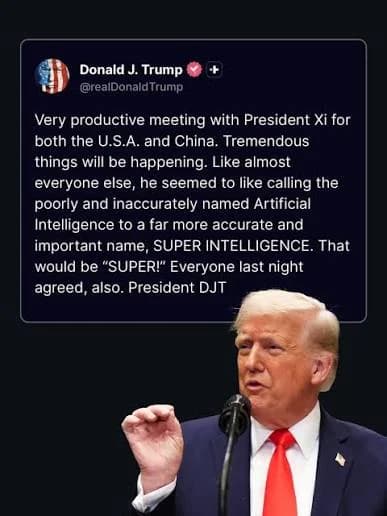
- The Trump "super intelligence" rebrand, analysed
- Superintelligence and today's tools: keeping the terms apart
Evidence in this article Editorial interpretation Our reading of what the evidence means. Judgment, clearly separated from the evidence itself.
Frequently asked questions
What is the shift from AI to SI?
AI makes machines capable of intelligent tasks. SI, or superintelligence, is a hypothetical form of intelligence that would outperform the best humans across virtually every intellectual field. It has not been built, and nobody can say when it might arrive.
How do AI, AGI and SI differ?
AI makes machines capable of intelligent tasks. AGI would handle a broad range of intellectual tasks at a general level comparable to humans. SI would go beyond the strongest human capabilities across almost every intellectual field. They are not guaranteed stages in a sequence.
Can AI improve itself?
Researchers study related ideas, including automated AI development and recursive self-improvement, but the limits, speed and feasibility of such a process remain unknown. It is not a guaranteed intelligence explosion.
Does more intelligence mean a better world?
Not automatically. Powerful AI could accelerate discovery, but it could also be misused, make consequential mistakes, concentrate power or behave unpredictably, which is why safety matters as much as capability.
Sources
This article is editorial analysis. It cites no external sources and contains no product performance claims, benchmark figures, or policy facts.