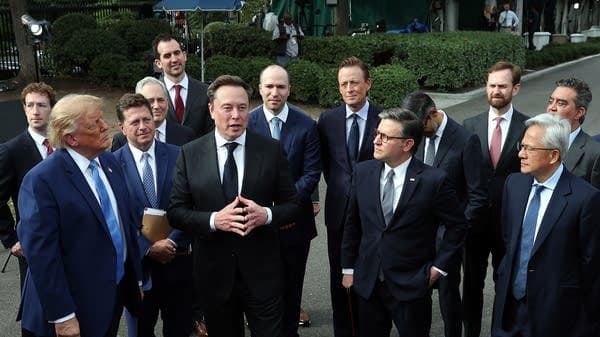
On September 29, 2026, President Donald Trump signed an executive order instructing federal agencies to strike the words artificial intelligence from official communications and replace them with Super Intelligence and SI.
His objection to the old term was characteristically blunt: artificial sounds fake, like imitation leather, while super intelligence sounds dominant. In the administration's framing, the new label simply recognizes an unprecedented American technological era. (White House executive order.)
It is an audacious branding exercise. But beneath the nationalist rhetoric sits a concrete reality: The White House ordered civil servants to change their vocabulary; it did not alter a single line of model weights, fix a hallucination, or prove that existing neural networks have suddenly surpassed human intellect.
Separating political branding from technical substance clarifies what this directive actually changes, and where its legal authority stops.
What happened: Trump’s official AI rebrand
The shift unrolled in public over seven days in late September.
Addressing the United Nations General Assembly on September 22, Trump told world leaders that the United States was retiring the term artificial intelligence in official records in favor of super intelligence. Calling the technology artificial, he argued, diminished its power. (BBC News coverage.)
Seven days later, that rhetorical flourish became federal policy with Executive Order 14434, “Inaugurating the Era of Super Intelligence.” The order instructs executive departments and agencies, to the maximum extent permitted by law, to adopt “Super Intelligence” and “SI” instead of “Artificial Intelligence” and “AI” in official correspondence, public communications, websites, reports, and policy papers.
Look past the headline, however, and the administrative guardrails emerge immediately.
First, the directive explicitly carves out exceptions: agencies do not have to reopen previously enacted regulations, renegotiate existing federal contracts, or rewrite historical archives. Second, Section 3 anchors “Super Intelligence” directly to the existing statutory definition of artificial intelligence under 15 U.S.C. § 9401(3). Until officials draft a new definition for Congress to consider, the administration has merely pasted a new label over the existing law.
What changes, and what does not?
| Area | What the order means |
|---|---|
| Federal communications | Agencies are directed to adopt “Super Intelligence” and “SI” in covered official communications. |
| Government websites and reports | Staff are instructed to swap terms across public portals, press releases, and non-statutory reports. |
| Existing legal documents | The order does not require historical documents, previously issued regulations, contracts, or grants to be rewritten. |
| Private companies | The order imposes no naming mandates on private software developers, researchers, or startups. |
| Technical capabilities | A presidential memo does not alter model architecture, benchmark accuracy, or safety reliability. |
| Federal definition | The order relies on the existing statutory AI definition under 15 U.S.C. § 9401(3) while directing officials to propose new legislative language. |
A president commands vast authority over executive branch memos and agency press releases. He cannot dictate the vocabulary of Silicon Valley, force arXiv researchers to rename their preprints, or mandate what enterprise buyers write into private procurement contracts. Washington can insist on the acronym “SI,” but outside the Beltway, the technology industry speaks its own language.
Why “super intelligence” is a much bigger claim than “artificial intelligence”
In computer science and philosophy, artificial intelligence and superintelligence are not synonyms. Collapsing the two erases decades of technical precision.
Artificial intelligence is the broad scientific discipline established in 1956, covering computational systems that perform discrete tasks: predicting text, classifying imagery, generating audio, or optimizing complex logistics.
Frontier AI refers to cutting-edge foundation models and autonomous coding agents. These systems operate at the current boundary of capability, yet remain constrained by context windows, training data distributions, and persistent hallucination rates.
Superintelligence carries a vastly more demanding definition in technical literature. Popularized by philosopher Nick Bostrom’s 2014 book Superintelligence, it describes an intellect that vastly exceeds human cognitive performance across virtually every field, from scientific discovery to social reasoning. A recent analysis in Nature highlights how the administration's broad rebrand conflicts with this established scientific usage. (See also our glossary definition and Superintelligence and today’s tools.)
Conflating an everyday enterprise tool with superintelligence fundamentally misrepresents how machine learning functions.
A model can score in the 90th percentile on a coding benchmark while failing an elementary logic puzzle or fabricating sources for a recent news event. High performance in a bounded domain is not proof of universal intellectual dominance. (We break down this distinction in reading benchmark claims critically.)
Software does not need to be 'superintelligent' to automate workflows, accelerate research, or generate billions in enterprise value. But slapping the label onto conversational chatbots and predictive autocomplete dilutes genuine technical scrutiny.
The executive order contains a revealing contradiction
The most telling paradox sits inside the text of the order itself.
The White House insists that artificial intelligence is an outdated term that fails to capture the frontier's magnitude. Yet when it comes to the legal definition, Section 3 falls back on the exact statutory definition enacted under the National Artificial Intelligence Initiative Act of 2020 (15 U.S.C. § 9401(3)).
The administration demands the futuristic prestige of a new brand, but government lawyers had to tether it to existing statute to avoid regulatory chaos. Modifying the statutory category requires an act of Congress. So the executive branch finds itself in an awkward compromise: declaring an era of 'Super Intelligence' while legally defining it through the very statute it claims to have outgrown.
Trump’s rebranding strategy: changing the story around technology
For decades, Donald Trump’s political communication has relied on christening institutions, opponents, and initiatives with indelible nicknames. Language is treated as contested territory: win the naming rights, win the narrative.
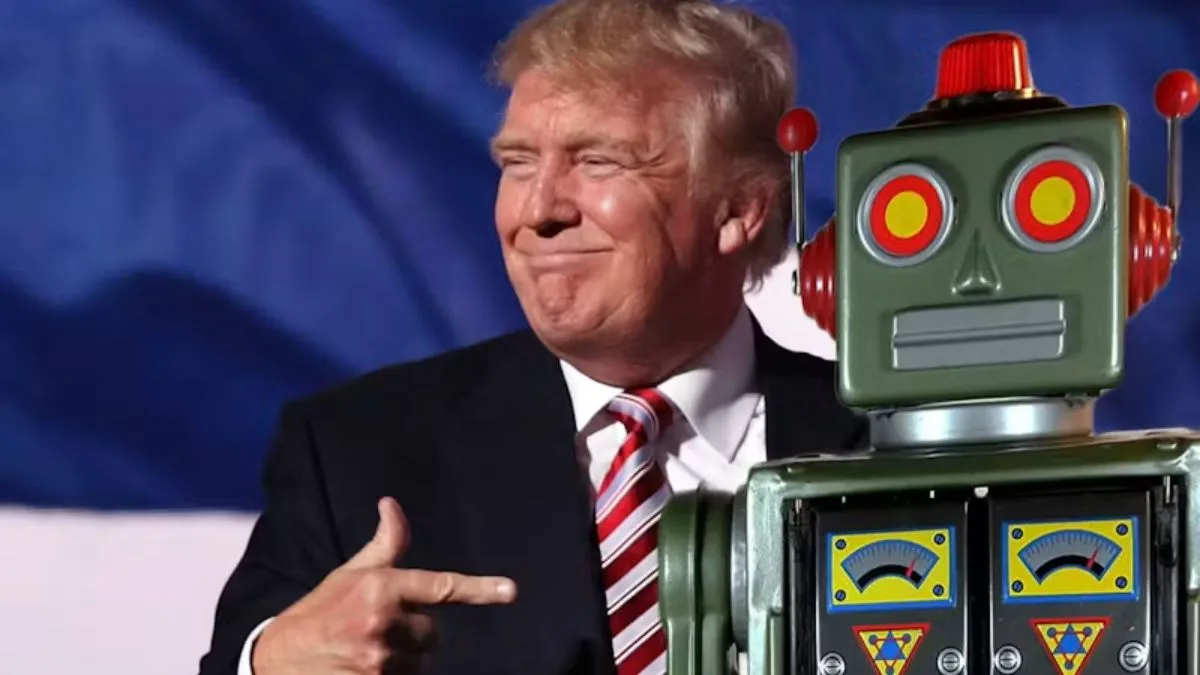
In public debate, the term artificial intelligence carries heavy baggage: algorithmic bias, deepfakes, copyright infringement, white-collar displacement, and corporate concentration.
Replacing it with Super Intelligence attempts to steer public attention away from systemic vulnerabilities and toward geopolitical conquest, raw computing power, and economic dominance.
The strategic utility is evident. If software is branded 'superintelligent,' backing it becomes a patriotic imperative, and regulating it can be portrayed as unilateral disarmament against foreign adversaries. Framing AI as a national triumph rather than an unvetted risk clears political ground for deregulation and massive infrastructure subsidies.
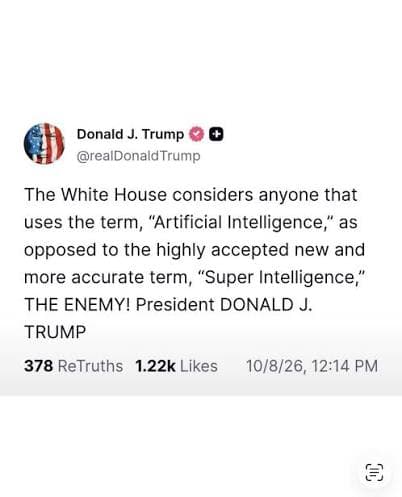
On October 8, Trump underlined the political stakes on social media, declaring that the administration considers anyone insisting on the term “Artificial Intelligence” instead of “Super Intelligence” to be “THE ENEMY!” It was not an invitation to academic debate; it was an enforcement mechanism.
From political messaging to institutional language
Executive orders do what speeches cannot: they force the federal bureaucracy to internalize a slogan.
Within days of the signing, the Department of Justice distributed internal guidance instructing prosecutors and agency staff to use “super intelligence” and “SI” across departmental correspondence, reports, and, where legally viable, federal court filings (Reuters). Federal grant solicitations, procurement RFPs, and agency press shops will inevitably follow.
Repetition breeds normalization. When government agencies, defense contractors, and legal departments write “SI” into official records thousands of times a week, the phrase begins to sound established. But bureaucratic compliance is not scientific verification. Federal memos cannot turn statistical pattern matchers into sentient superintelligences.
The technology industry is not a single voice
Silicon Valley’s reaction quickly split along political and commercial fault lines.
Tech executives eager to court administration favor immediately adopted the branding. Elon Musk announced on X that SpaceX would rechristen its internal division from “SpaceXAI” to “SpaceXSI” (Reuters). Other founders leaned into the hyperbole, recognizing that 'super intelligence' helps justify multi-billion-dollar infrastructure valuations and capital expenditure.
Elsewhere, the reaction has been eye-rolling skepticism. Researchers speaking to *Nature* stressed that technical literature relies on AI as a well-defined taxonomic umbrella, warning that co-opting 'superintelligence' creates consumer confusion and muddies risk governance.
Language in tech faces powerful network effects. Global developers, European regulators enforcing the EU AI Act, open-source maintainers, and academic peer reviewers are under zero obligation to salute the White House's style guide. Marketing decks may embrace the hype, but technical API documentation and commercial contracts cannot afford ambiguous phrasing. (This is why we separate vendor marketing from verified evidence; see vendor claims vs. verified findings.)
The voluntary industry accord: a separate policy story
Flanking the executive order on September 29 was a high-profile corporate signing ceremony: the Joint Commitment on Frontier Responsibilities.
Standing alongside Trump, tech executives pledged voluntary commitments around internal safety audits, red-teaming, and frontier monitoring. But observers must avoid confusing ceremonial photo ops with enforceable regulation.
A voluntary accord is not law. It carries no civil penalties, creates no independent inspection authority, and offers no binding legal recourse if a vendor quietly drops its safeguards under competitive pressure. Washington has seen decades of voluntary tech pledges dissolve the moment commercial priorities shift.
The credibility of any safety commitment rests on verifiable telemetry, published audit results, and independent validation, not executive handshakes in the Rose Garden:
- What specific controls are companies committing to implement?
- Who verifies that those commitments are honored in production?
- Are internal safety audits conducted by independent third parties?
- What enforcement mechanisms trigger if a company quietly fails an audit?
- Which models and compute thresholds are covered by the pledge?
- What monitoring telemetry is shared with the public?
These questions matter far more than whether a press release uses the acronym AI or SI. A pledge's worth comes from its operational accountability, not the ambition of its title.
Does the rebrand signal a shift away from AI regulation?
Beyond semantics, the rebrand provides the ideological foundation for the administration’s broader deregulatory agenda.
By framing the technology as 'super intelligence' vital to beating geopolitical rivals, the White House establishes a rhetorical premise: slowing down for safety reviews or compliance hurdles harms American national security. In this narrative, regulation is no longer consumer protection; it is economic sabotage.
Yet analysts must separate political rhetoric from administrative reality. An executive order cannot override statutory mandates passed by Congress, nor does it shield federal agencies from judicial review under the Administrative Procedure Act. When agency actions face legal challenges, federal judges interpret statutory text, not White House press releases.
What to watch next
Five developments will determine whether this rebrand gains enduring traction or fades as an administrative curiosity:
- The proposed federal definition. The order calls for legislative language within 60 days. Its text will reveal whether the administration intends a genuine legal overhaul or merely cosmetic wordsmithing.
- Agency compliance in the courts. Court filings from the Justice Department and regulatory agencies will test whether federal judges accept 'SI' in formal proceedings without statutory backing.
- Global and enterprise adoption. Whether enterprise buyers, global developers, and standards bodies adopt the term or quietly stick with standard computer science terminology.
- Voluntary accord accountability. Whether signing companies publish verifiable audit results or treat the accord as ceremonial PR.
- Congressional action. Whether lawmakers introduce legislation adopting the terminology or leave it confined to executive branch memos.
Why this matters to the public
The debate may sound like semantic trivia, but language shapes how buyers, investors, and the public evaluate risk and value.
If software is labeled superintelligent, an enterprise buyer or healthcare administrator might reasonably infer that it can reason with superhuman accuracy. If that system is actually a statistical model prone to hallucinations and edge-case failures, the label manufactures unwarranted trust.
A rigorous evaluation asks concrete, empirical questions regardless of branding:
- What specific tasks can the system complete without human intervention?
- Under what conditions and workloads does it fail?
- How often does it hallucinate or produce incorrect code?
- Can its outputs be independently checked and audited?
- Where is prompt and customer data transmitted, stored, and retained?
- What human oversight is required to catch critical failures?
- What verified telemetry exists to support the vendor's claims?
These questions cut through marketing whether a company calls its product artificial intelligence, super intelligence, an autonomous agent, or something else. Our guide to how to read an intelligent-software evaluation and our methodology lay out this framework in detail.
At BestSuperintelligent.com, our standard is straightforward: software should be judged by its verified performance and architectural boundaries, not by how futuristic its title sounds.
What this rebrand does, and does not, prove
Separating verifiable facts from political interpretation:
- What the evidence establishes:
- Trump signed Executive Order 14434 on September 29, 2026, directing agencies to use “Super Intelligence” and “SI” in covered communications where law permits.
- Section 3 explicitly anchors the new terms to the existing statutory definition of AI under 15 U.S.C. § 9401(3).
- The order directs officials to propose legislative language for a new federal definition within 60 days.
- The Justice Department has issued implementation memos extending the terms to departmental documents and court filings where appropriate.
- Tech executives signed a separate voluntary accord pledging safety checks and frontier monitoring.
- What those facts do not establish:
- That any current AI model has achieved superhuman cognitive capabilities.
- That altering federal vocabulary improves software accuracy, security, or reasoning.
- That voluntary corporate pledges carry the legal weight of binding federal regulation.
- That the executive order alters existing statutory duties or international legal frameworks.
- That the global scientific community or software industry will abandon standard AI terminology.
The verdict: political theater, not technological disruption
Executive Order 14434 is an aggressive move in political theater and federal administrative styling, not an inflection point in artificial intelligence capabilities.
Governments can decree what their bureaucrats write in memos. They can replace three syllables with five. But whether a model is capable, reliable, secure, or safe depends on empirical testing, not presidential decrees.
The real question is not whether AI should be called SI. It is whether the software behind the label can deliver what its developers and political champions promise, and whether those claims survive independent verification.
Frequently asked questions
Did Trump officially rename artificial intelligence “super intelligence”?
Trump signed Executive Order 14434 on September 29, 2026, directing executive agencies to use “Super Intelligence” and “SI” in official communications where law allows. It alters federal government terminology, not the English language or private industry standards.
What is the difference between AI and superintelligence?
AI describes any computational system performing tasks like text generation, coding, or pattern recognition. Superintelligence refers to a theoretical threshold where a system's cognitive abilities vastly exceed human intellect across virtually every field. Applying 'superintelligence' to current generative models stretches a technical term into a marketing slogan.
Does the executive order mean current AI systems are superintelligent?
No. The executive order dictates agency branding, not computer science reality. In fact, the order legally anchors “Super Intelligence” to existing statutory definitions of AI under 15 U.S.C. § 9401(3). Rebranding software by presidential decree does not grant it superhuman capability.
Are private AI companies required to adopt the new name?
No. The president's directive applies strictly to executive branch agencies. Private companies, academic labs, and international developers can call their systems whatever they like, though some vendors may echo the phrase to court federal favor.
What is the Joint Commitment on Frontier Responsibilities?
A voluntary corporate pledge announced alongside the executive order, where tech leaders agreed to internal safety checks and frontier monitoring. It carries no legal force, creates no statutory enforcement authority, and imposes no binding penalties if companies fail to comply.
Will the rebrand change AI regulation?
Not on its own. Swapping labels on government letterhead does not repeal laws enacted by Congress or undo standing court precedents. However, it signals a strong White House push toward deregulation by framing AI oversight as a handicap in a high-stakes geopolitical race.
Sources
- Executive Order 14434: Inaugurating the Era of Super Intelligence — The White House (primary source). The authoritative text of the order.
- Fact Sheet: President Donald J. Trump Inaugurates the Era of Super Intelligence — The White House (primary source). The administration's explanation of the policy.
- US Justice Department tells staff to call AI 'super intelligence' under Trump order — Reuters. Reporting on implementation at the Justice Department.
- Trump wants AI to be rebranded as super intelligence. Will it work? — BBC News. Background on the announcement and reactions.
- The science of superintelligence and why AI is still a useful word — Nature. Discussion of the technical meaning of superintelligence and the terminology debate.
- White House Accord on Super Intelligence — The American Presidency Project. Text of the separate voluntary industry commitment.