Guide
Questions to ask about AI data retention and training
Five questions that expose what happens to your data in any AI tool, and how to get answers you can rely on.
At a glance
- Type
- Guide
- Evidence
- Editorial interpretation
- Written by
- Adam Green
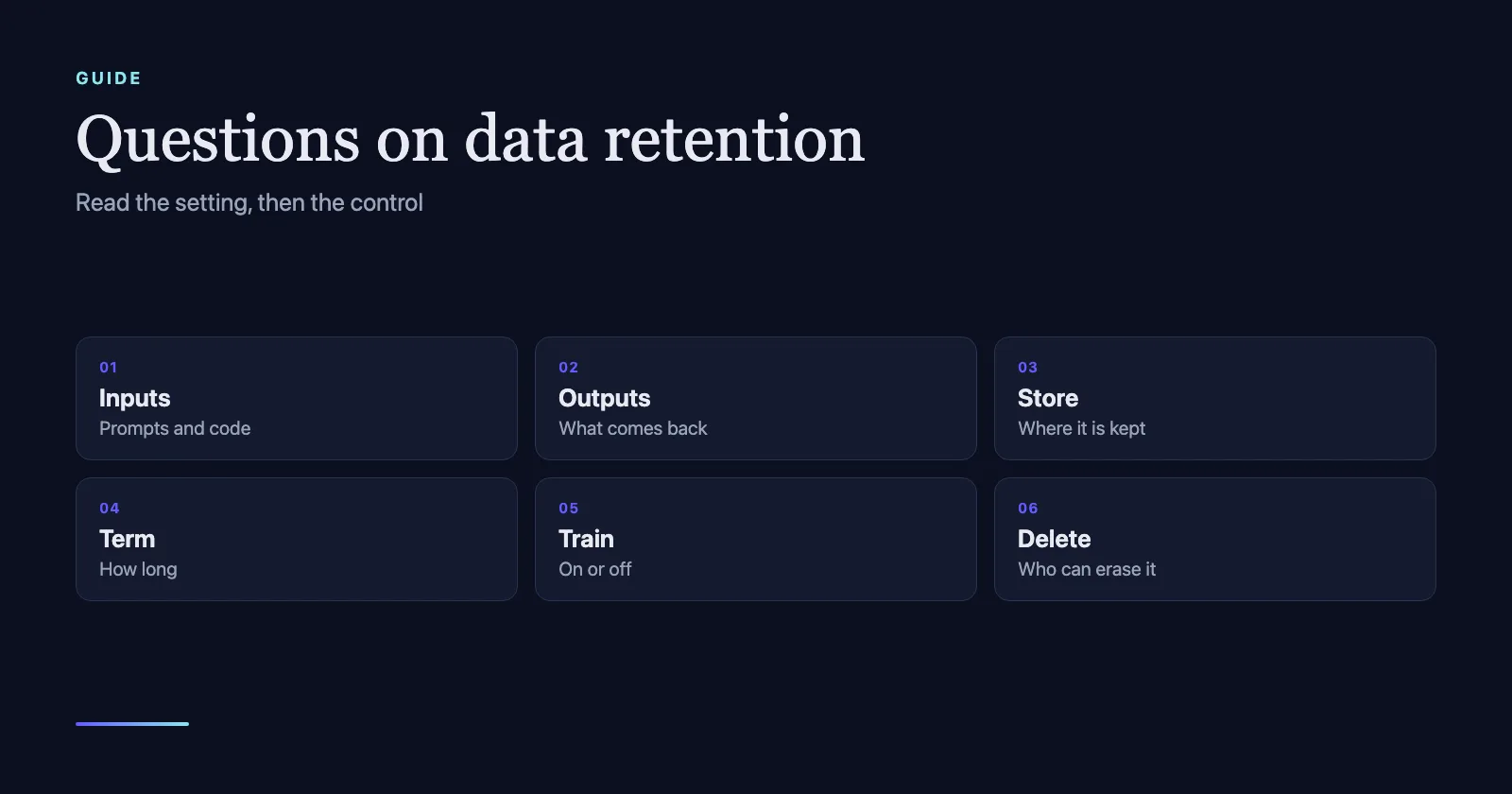
Vendor statements about data are claims, and they are often specific to a plan. Use these questions to get precise answers. This guide is general information, not legal advice.
What data does the tool receive?
List what you will actually send: prompts, files, source code, recordings, customer records. Then check whether the tool also collects usage or telemetry data, and whether you can turn that off.
How long is my data kept?
Look for a stated retention period, and whether it differs for prompts, outputs, and logs. Some vendors offer zero-retention arrangements for qualified accounts; find out what qualifies and who must request it.
Is my data used to train models?
Find the exact wording for your plan. A default of no training is different from an opt-in or opt-out setting, and different again from a contractual commitment. Record where the statement appears and the date you read it.
Who else can access my data?
- Subprocessors and cloud providers that handle data on the vendor's behalf.
- Vendor staff, for example for safety review or support.
- Other users in your organization, through the tool's own permissions.
How do I delete my data?
Ask for the deletion process, its timeline, and what remains in backups or logs. For regulated data, ask how deletion is evidenced.
Related: how to read a vendor security page and procurement guidance.
How do I map my data before asking questions?
Start by listing what you will really send and how sensitive it is, because the right questions depend on it. This is general information, not legal advice.
| Data you might send | Sensitivity question | Extra question to ask |
|---|---|---|
| Public text and general questions | Low: would you post it publicly? | Is account history kept, and can you clear it? |
| Internal documents and source code | Medium: would a leak harm the business? | Is it excluded from training on your plan, in writing? |
| Customer or employee personal data | High: privacy obligations may apply | What are the processing terms, subprocessors, and locations? |
| Regulated data (health, finance, children) | Very high: specific rules may apply | Has your compliance team or counsel approved this tool and plan? |
What does a completed answer sheet look like?
Keep one row per question, with the source and date, so the file can be audited later. The row below is an invented illustration of format, not a statement about any real vendor.
| Question | Answer found | Source | Date read | Status |
|---|---|---|---|---|
| Used for training? | Not stated for the team plan | Help page, no plan named | (fill in) | Unverified |
| Retention period? | A figure stated for chat history only | Settings documentation | (fill in) | Vendor-reported; logs not covered |
| Deletion process? | Account deletion described; backups not mentioned | Terms | (fill in) | Partly answered |
Why do I need the answer for my exact plan?
Consumer, team, and enterprise offerings are often governed by different terms, so an answer for one plan does not carry over to another. Confirm the plan name in the text you are reading, and check that the plan you are buying is the one the text describes.
- Look for the plan name in the sentence or heading, not just on the page.
- Check whether a setting is on by default or must be switched on by an administrator.
- Ask whether the setting can be changed by individual users, which could weaken a team policy.
- Ask what happens to data collected before you changed the setting.
Which kinds of answer are strongest?
Rank answers by how enforceable and how specific they are. This ordering is editorial interpretation.
- A term in your signed contract or data processing addendum for your plan.
- Published terms of service or product terms that name your plan.
- Product documentation that describes the behaviour and date.
- A general marketing or FAQ statement without a plan or date.
- A verbal or chat answer from sales, which should be requested in writing.
What are common mistakes when asking about data?
- Asking only 'is it secure?', which invites a reassurance rather than an answer.
- Conflating 'we do not sell your data' with 'we do not train on your data'. These are different statements.
- Assuming deleted means gone everywhere. Ask about logs, backups, and exports.
- Forgetting integrations. Connectors and plugins may send data to other parties with their own terms.
- Letting each employee decide for themselves which account to use for work content.
What evidence would settle a data-handling question?
Settling checklist
- WrittenThe answer appears in a document you can keep, not in a call.
- Plan-specificThe text names your plan or your contract.
- DatedYou know when it was published or last updated, and you have recorded the date you read it.
- CompleteIt addresses logs, backups, and subprocessors, or states what it excludes.
- TestableWhere a setting exists, an administrator has confirmed it in the product, not only in the documentation.
What should I do next?
Fill in the answer sheet for the tool and plan you are considering, and mark every gap as unverified. Then use how to read a vendor security page for the security claims, the procurement evidence checklist for the questions to put to a vendor, and hosted vs. self-managed questions if keeping data in your own environment is an option. For how this site labels claims, see vendor claims vs. verified findings and the methodology.
Evidence in this article Editorial interpretation Our reading of what the evidence means. Judgment, clearly separated from the evidence itself.
Frequently asked questions
Is data retention the same as training use?
No. Retention is how long data is stored. Training use is whether the vendor uses it to improve models. A vendor can retain data without training on it, or the reverse, so ask about both.
Do free and paid plans handle data the same way?
Often not. Terms can differ between consumer, team, and enterprise plans, so check the terms for the exact plan and ask for the answer in writing for business use.
Can I delete my data after I stop using a tool?
Ask how deletion works, how long it takes, and whether copies in logs or backups are covered. Vendor documentation or the contract should say.
Related reading
- Category: Writing & productivity
- Category: Research & knowledge
Sources
This article is editorial analysis. It cites no external sources and contains no product performance claims, benchmark figures, or policy facts.